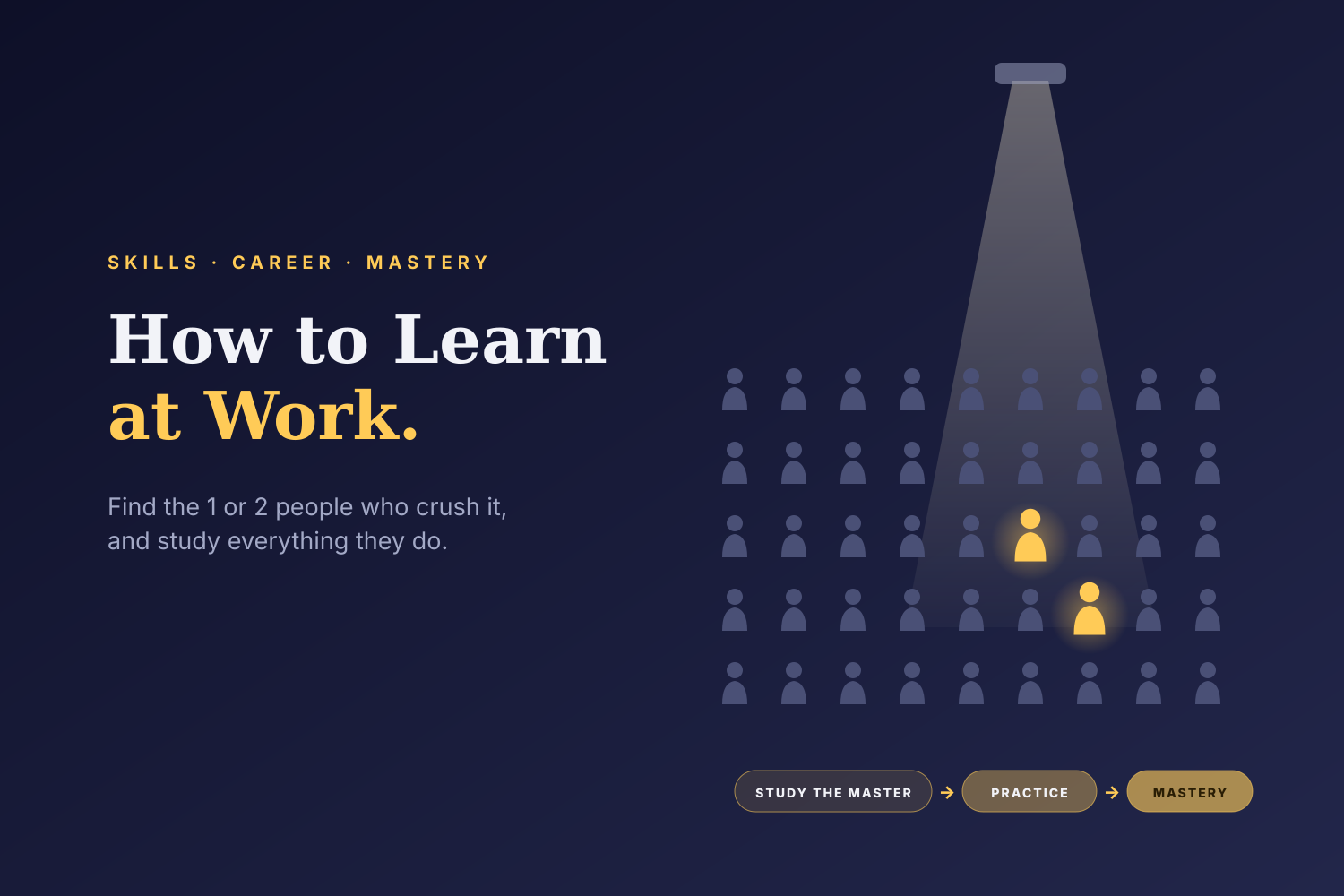
Here’s the fastest way I know to learn at work:
Find the people who are best at whatever you’re paid to do, and study everything about them.
That’s literally all it takes to get started. Of course, you also need to be writing, thinking, experimenting, and creating situations where you can practice what you’re learning from the masters. Watching alone won’t get you there. But studying the best is the shortcut most people skip.
We should all be seeking mastery in ourselves. And to become a master, you need to learn from the best.
It’s Going to Be 1 or 2 People
In almost every office, team, or company, there are one or two people who absolutely crush their job. They operate at a level so much higher than everyone else that it’s obvious. They have it figured out.
This lines up with the Pareto Principle, the idea that roughly 80% of results come from 20% of the effort or people. In a lot of teams, it’s even more extreme than that. A small handful of top performers drive a huge share of the results.
How do you spot them?
- Leadership trusts them with the biggest clients and toughest problems.
- Other people go to them for help, even when it isn’t their job.
- Their results are consistently better, not just occasionally lucky.
- They explain complicated things simply.
- They seem calm when everyone else is scrambling.
How to Learn From Them
Once you know who they are, get as close to their work as you can:
- Go to every meeting they lead. Watch how they run the room, handle pushback, and make decisions.
- Ask for short bursts of their time. An A-player’s time is extremely valuable, so keep it brief and come prepared with specific questions.
- Dissect the technical details. Ask why they set up a campaign a certain way, how they analyze a report, what they look at first.
- Study their work. Read their emails, decks, reports, and strategies whenever you can. Notice the patterns.
- Offer to help. Volunteer for projects they’re leading. You’ll learn more by doing the work alongside them than by watching from the sidelines.
- Give back. Share useful findings, take something off their plate, or make them look good. Mentorship works best when it goes both ways.
This process dramatically speeds up your learning curve. You’ll make serious career moves, earn more money, have more fun, and eventually land in the top 5% of your field, where the big money is.
Practice Like You Mean It
Studying the masters is step one. Step two is putting it into practice.
The late psychologist Anders Ericsson, who spent his career studying expert performance, found that what separates experts isn’t just time spent but how that time is spent. He called it deliberate practice: working on specific weaknesses, getting fast feedback, and constantly pushing just beyond your comfort zone.
At work, that looks like:
- Picking one skill to improve each month
- Asking for honest feedback on your work, not just approval
- Testing what you learned from the masters on your own projects
- Writing down what worked, what didn’t, and why
- Repeating the cycle until it becomes second nature
Learning at Work in 2026
When I first wrote this, “sit at their desk” was literal advice. Today, a lot of us work remotely or on hybrid schedules, so the master might be three time zones away. The principle is the same, but the tactics have changed:
- Ask to shadow calls. Joining a top performer’s client call or strategy session over video is the new desk visit.
- Request screen-share walkthroughs. Fifteen minutes watching how they build a campaign or analyze data can teach more than a week of guessing.
- Read the written trail. Remote teams document everything in Slack, docs, and project tools. Study how the best people communicate in writing.
- Record and replay. If meetings are recorded, rewatch the ones led by the best people and take notes.
- Use AI as a tutor. AI tools can explain concepts, quiz you, and help you practice. They’re a great supplement, but they don’t replace the judgment you pick up from watching an expert handle a real situation.
Remote work actually makes one thing easier: the best people in your company are no longer limited to the ones who sit near you. Look across the whole organization, and reach out. A short, specific message like “I loved how you handled that client review. Could I grab 15 minutes to ask how you prepped for it?” gets a yes far more often than you’d think. Most top performers enjoy talking about their craft with someone who genuinely wants to learn.
Learning From Masters Outside Your Office
Your coworkers aren’t the only masters you can study. The top people in almost every field are online, sharing their knowledge through emails, social content, blogs, podcasts, webinars, and videos.
And notice how they do it. Many of them pull you in through well-built marketing funnels. Free content builds trust, then an email list, then a course, a book, or a coaching program. They get paid, and they rinse and repeat.
Two lessons there. First, the free content is often excellent, so take advantage of it. Second, study the funnel itself. It’s a masterclass in marketing. Just be choosy about what you pay for. Look for people with real track records, not just big followings.
Become the Master
Eventually, if you keep studying, practicing, and improving, something interesting happens: you become one of the 1 or 2 people others want to learn from.
When that happens, pay it forward. Make time for the hungry people who come to you with good questions. Teaching others is one of the best ways to deepen your own mastery, and it builds the kind of reputation that opens doors for the rest of your career.
The Bottom Line
Find the best. Study them closely. Practice what you learn. Repeat until you’re the one being studied. Whether you’re in an office, at home, or somewhere in between, this is the fastest path I know to mastery and to the top of your field.
Leave a Reply