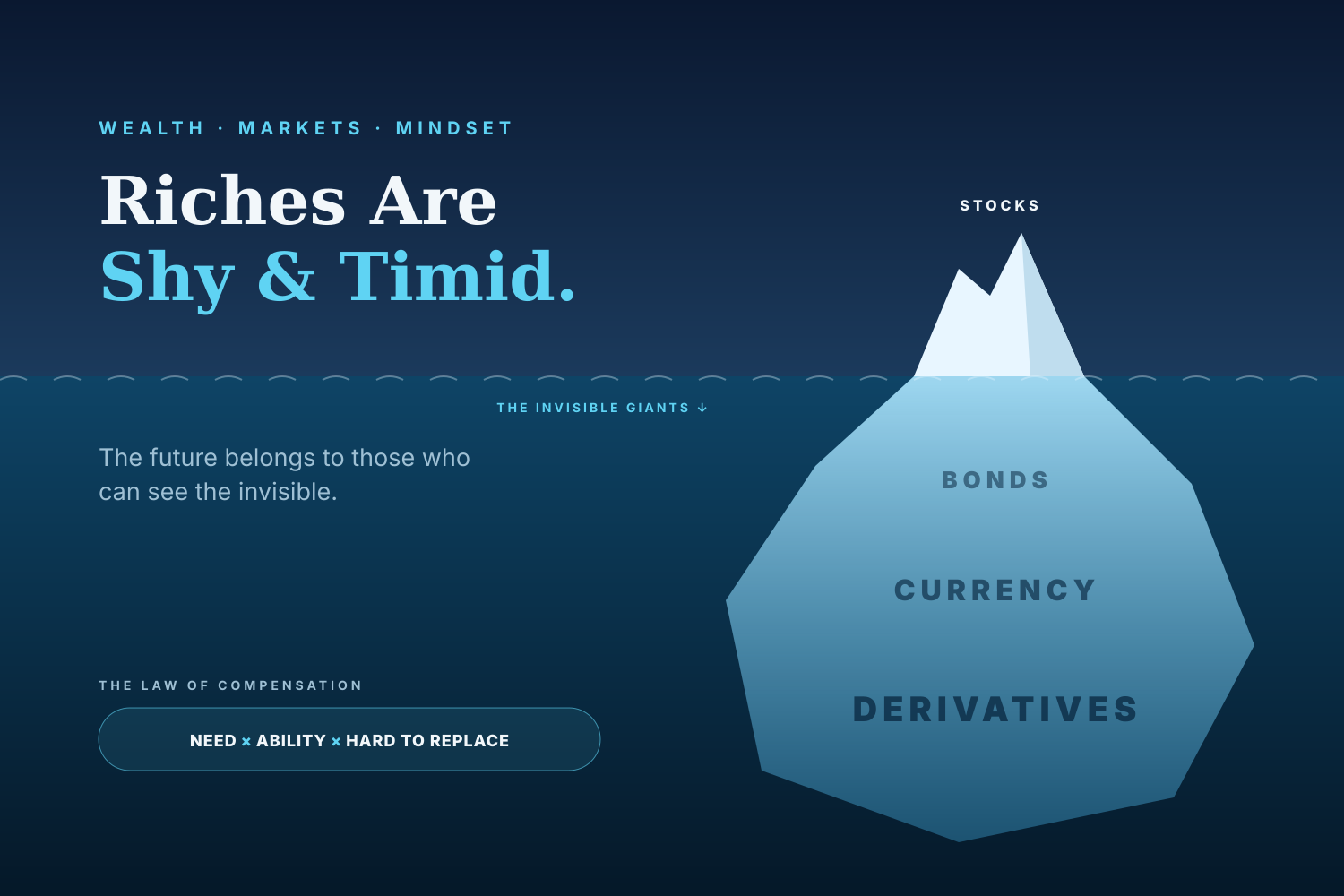
“Riches are shy and timid. They have to be attracted.”Napoleon Hill, Think and Grow Rich
If you want to be rich, you have to attract riches. Money doesn’t chase people. It flows toward people who create value, solve problems, and understand how the game actually works.
So let’s start with a riddle.
The Riddle
How do I become financially free 20 to 30 years ahead of schedule?
That’s the economic riddle worth solving. The traditional plan says work for 40 years, save a little, and retire at 65. If you want a different outcome, you need a different strategy. Here are the three clues I’ve found most useful.
Clue #1: The Law of Compensation
Earl Nightingale, one of the original voices of personal development, explained it simply. How much you earn depends on three things:
- The need for what you do. How badly does the market want it?
- Your ability to do it. How good are you?
- The difficulty of replacing you. How many other people can do it just as well?
Raise any of these three, and your income goes up. Raise all three, and it can go up a lot.
This is why a great surgeon earns more than a cashier. It isn’t about who works harder. It’s about need, skill, and how hard you are to replace. The same rule applies to marketers, real estate investors, and business owners.
The 2026 twist: AI is changing the third factor fast. If a machine can do your job, you’re easy to replace, and your pay will reflect it. The people who win now combine skills AI can’t easily copy: judgment, relationships, creativity, and the ability to direct AI tools well. Become hard to replace, and riches start paying attention.
Clue #2: See Past the Paycheck
A paycheck trades your time for someone else’s wealth. That’s not evil. It’s a fair deal, and it’s how most of us get started. But a paycheck alone almost never makes anyone free early.
The people who solve the riddle use the paycheck as a launch pad. They save aggressively, build skills, and turn earned income into assets: businesses, real estate, and investments that keep paying them whether they show up or not.
Inventor and futurist Buckminster Fuller argued that much of humanity lives in a kind of modern Dark Age. Not one with bars or chains, but one locked in place by misinformation and the wrong mental map. I think about money the same way. Most people aren’t trapped by a lack of opportunity. They’re trapped by never being taught how money works.
Clue #3: Learn to See the Invisible
The future belongs to those who can see the invisible, people whose minds can see what their eyes can’t.
Fuller wrote about “invisible giants,” the massive forces that shape the economy but that most people never think about. Three of the biggest are financial markets most of us never touch directly:
- The derivatives market. Contracts whose value comes from something else, like interest rates, currencies, or stocks. Many work like insurance policies against price swings. The total notional value of over-the-counter derivatives is roughly $850 trillion.
- The currency market. Global foreign exchange trading runs into the trillions of dollars every single day, the largest financial market on Earth.
- The bond market. Governments and companies borrowing money. It sets interest rates for everything from mortgages to car loans.
You don’t need to trade any of these to get rich. But understanding them helps you see why interest rates move, why the dollar rises and falls, and why your mortgage rate changes. That’s seeing the invisible.
Myth vs. Reality
One popular number deserves a quick correction. You may have seen claims that the derivatives market is worth more than a quadrillion dollars. Here’s the reality:
| Myth | Reality |
|---|---|
| Derivatives are worth $1 quadrillion+ | That’s notional value, a reference amount used to calculate payments, not money at risk. |
| That money could vanish in a crash | The actual market value of OTC derivatives is closer to $23 trillion, about 2.7% of notional. |
| Derivatives are pure gambling | Many are used to hedge risk, like airlines locking in fuel prices. |
| You need to trade them to get rich | Most wealthy people never touch them directly. |
Seeing the invisible also means seeing past scary headlines to what the numbers actually mean.
How I’m Applying the Clues
This isn’t just theory for me. Each clue has shaped real decisions in my own life.
On the Law of Compensation: I went deep on performance marketing, a skill businesses badly need and few people do well. Over time, that made me harder to replace, first as an employee and now as a part owner and operator of an agency.
On the paycheck: I treated every W-2 job as a launch pad. Those paychecks funded house hacks, side projects, and savings until I could work for myself full time.
On seeing the invisible: Learning how interest rates and the bond market work helped me lock in low fixed-rate mortgages on my rental properties when money was cheap. That one piece of “invisible” knowledge has paid me back every single month since.
None of these moves were flashy. But stacked together over years, they’re how riches slowly start paying attention.
The Answer to the Riddle
So how do you become financially free 20 to 30 years ahead of schedule? Put the clues together:
- Make yourself hard to replace by building valuable, in-demand skills.
- Use your paycheck as a tool, not a finish line.
- Save a high percentage of what you earn.
- Turn savings into assets that produce income without you.
- Keep learning how money really works, including the invisible forces most people ignore.
Riches are shy and timid. They won’t come running just because you want them. But build value, own assets, and understand the game, and they’ll start showing up.
Solve the riddle for yourself. Start with one clue this week. Pick a skill that makes you harder to replace, move one more dollar from your paycheck into an asset, or spend an hour learning how one of the invisible giants works. Small moves, made consistently, are how you get decades ahead of schedule.
Leave a Reply