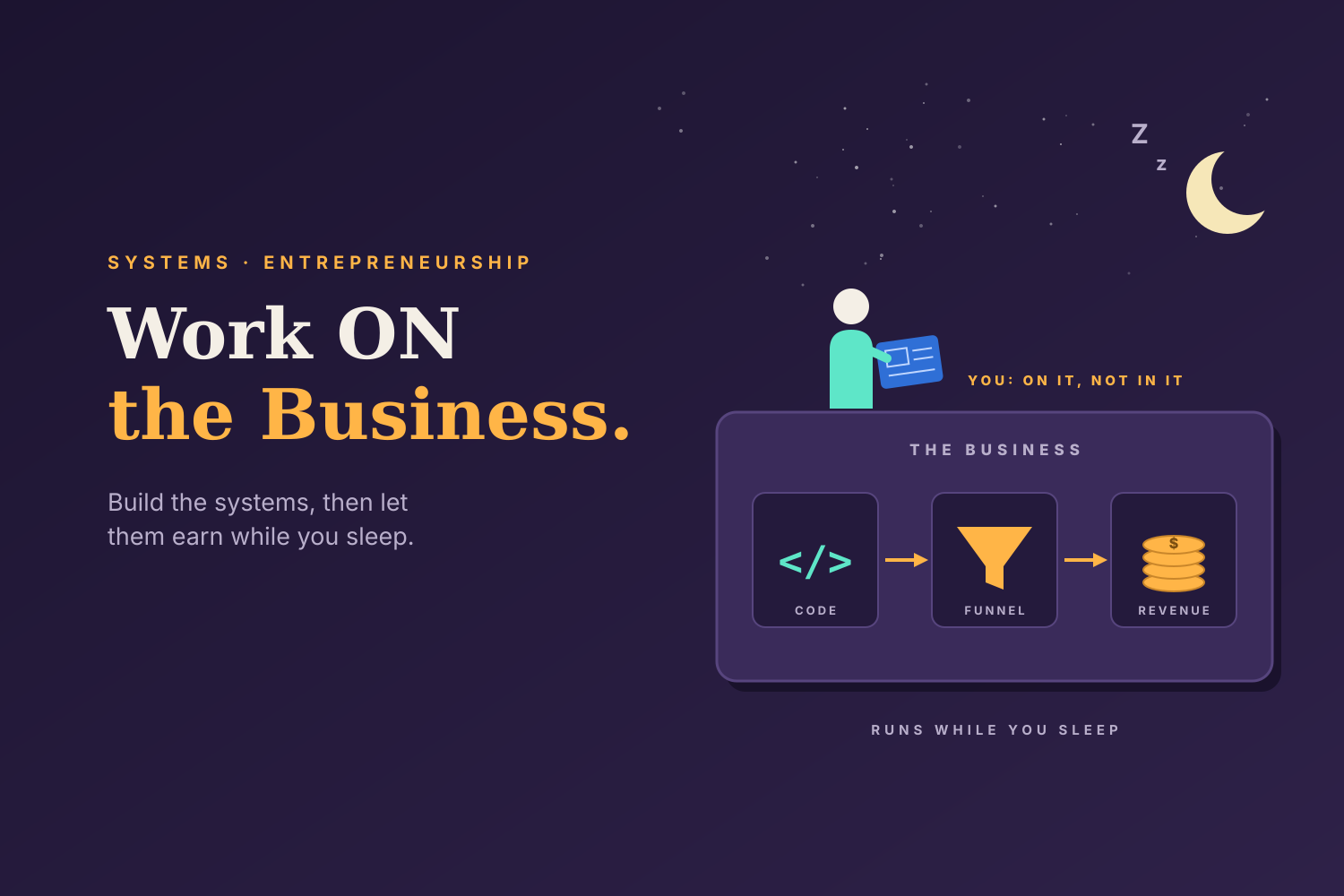
Don’t be the business. Build the business.
That’s the big idea. If the business only makes money when you personally show up and do the work, you don’t own a business. You own a job, and usually a very demanding one.
The goal is to work on the business, building the systems, assets, and team that make money, instead of working in it forever.
Being the Business vs. Building the Business
When you are the business, you’re usually selling a service. Taxes, contracting, consulting, freelance design, marketing. You trade your time for money. If you stop, the money stops.
When you build the business, you create things that work without you:
- A website or blog that attracts customers 24/7
- An online course that sells while you sleep
- Software that does the work for your customers
- An ecommerce store that runs on systems
- A team trained to deliver your service without you in every meeting
Even service businesses can make this jump. A tax preparer who hires other accountants, or a contractor who hires carpenters, and then builds a marketing and sales system that keeps them all busy, has stopped being the business. That’s when you start getting real time wealth, bigger pockets, and more creativity and fun in your work.
The Three Hats From The E-Myth Revisited
Michael Gerber’s The E-Myth Revisited explains this better than any book I’ve read. He says every small business owner is really three people wearing three different hats:
🔧 The Technician
The doer. The person who loves the actual craft, whether that’s building ads, fixing pipes, or baking bread. Most businesses are started by technicians who think, “I’m great at this, so I should run my own shop.”
📋 The Manager
The organizer. The person who builds processes, schedules, and systems, and makes sure things get done the same way every time.
🚀 The Entrepreneur
The visionary. The person who sees where the business is going and designs it to get there.
Gerber’s point is that most owners spend almost all their time as the technician. They’re so buried in the work that nobody is managing the systems or steering the ship. His fix is to build your business like a franchise prototype, with documented systems so clear that someone else could run it.
The business should make money while you sleep, because the processes and systems you’ve built can run on their own.
The Business Ownership Ladder
Here’s how I think about the climb from job to real business. Find your rung, then work on reaching the next one.
Level 1 · Self-employed. You do all the work. If you take a vacation, revenue drops to zero.
Level 2 · Systematized. Your processes are written down. You still do most of the work, but you could hand it off.
Level 3 · Leveraged. People, software, or AI handle most of the delivery. You manage the system and the key relationships.
Level 4 · Owner. The business runs without you day to day. You focus on strategy, growth, and new opportunities.
Not everyone needs to reach Level 4. Some people love the craft and want to stay close to it. That’s fine. But you should know which level you’re on, and choose it on purpose.
Code (and Now AI) Can Be Your Employees
This is why online businesses are so exciting. Code can be your employees. Or you can hire freelancers to write code that your business uses for years.
Investor Naval Ravikant put it well: code and media are forms of leverage that don’t require anyone’s permission. A blog post, a video, or a piece of software can work for you millions of times without you lifting a finger.
And in 2026, that leverage is bigger than ever. AI tools and agents can now handle a lot of the work that used to require hiring someone:
- Drafting reports, emails, and proposals
- Analyzing data and spotting trends
- Producing first drafts of ad copy and creative
- Answering common customer questions
- Automating repetitive admin tasks
A small team with great systems and good AI tools can now do what used to take a whole department. That makes working on the business more possible than ever, even for solo operators.
What This Looks Like for Me
I’m an owner-operator at heart. I love the craft of performance marketing, and I don’t think I’ll ever fully step away from it. But I’ve also learned the hard way that being the technician on every account doesn’t scale.
So I’m constantly pushing myself up the ladder. That means documenting how we launch and optimize campaigns, building reporting that doesn’t require me to pull every number by hand, and using AI to speed up the repetitive parts of the work. Every hour I free up goes back into strategy, client relationships, and growing the business.
It’s a work in progress. It probably always will be. But each system I build makes the business a little less dependent on me, and a lot more valuable.
Quick Self-Audit: Are You the Business?
Give yourself one point for every “yes”:
- Could you take two weeks off without revenue dropping?
- Are your core processes written down somewhere?
- Could a new hire learn your main service from your documentation?
- Do you spend at least a few hours a week on strategy, not just delivery?
- Does marketing bring in new customers without you personally chasing every one?
- Are you using software or AI to handle repetitive work?
0 to 2: You are the business. Start documenting what you do.
3 to 4: You’re building. Keep handing off the technician work.
5 to 6: You’re working on the business. Nice work.
Where to Start This Week
Pick the one task you repeat most often. Write down every step. Then ask: could software, AI, or another person do this? If yes, hand it off. Use the time you get back to work on the business.
Do that once a week for a year, and you’ll have a completely different business. One that serves your life, instead of one that runs it. That’s the whole point of owning a business in the first place.
Leave a Reply