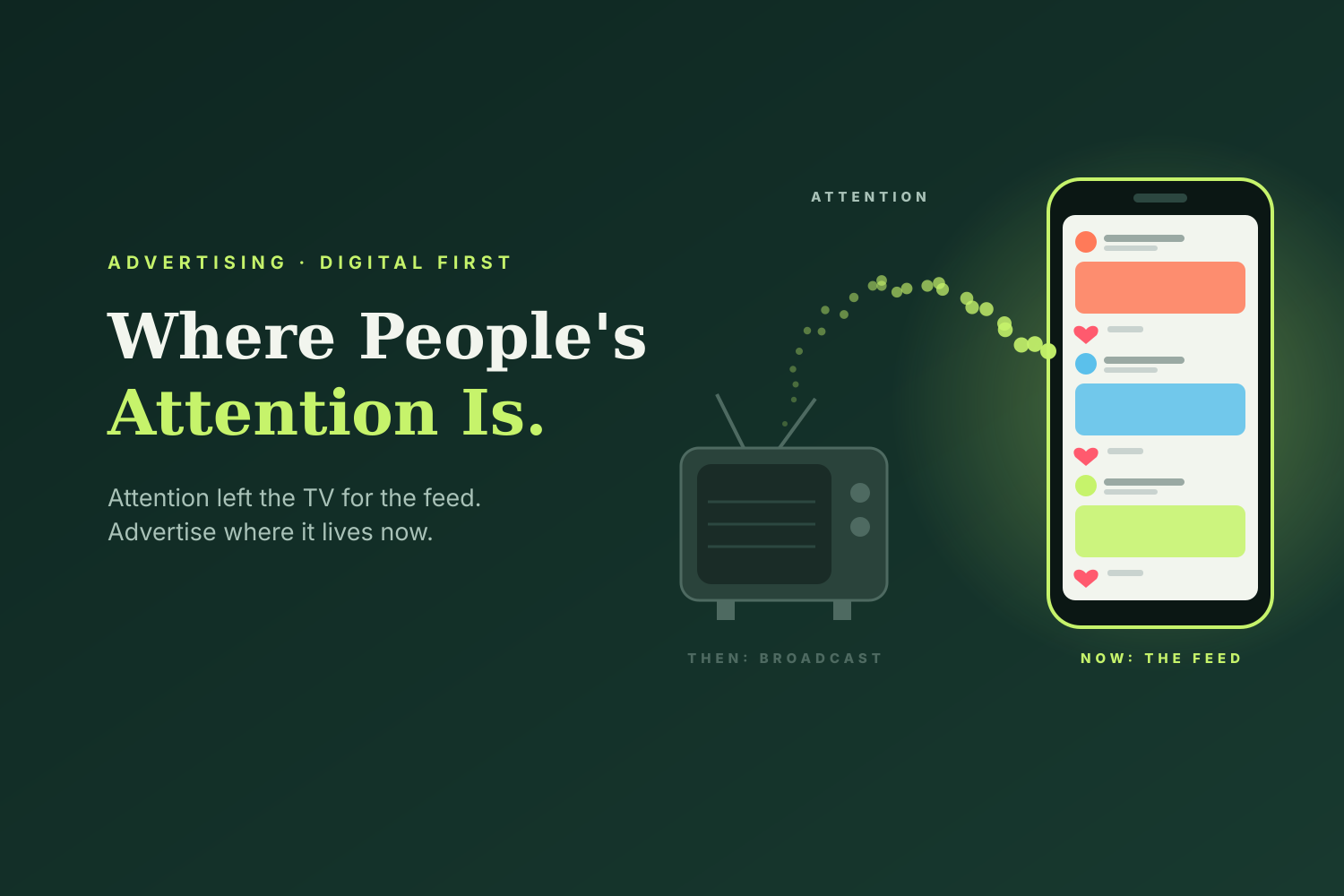
Follow the attention, and you’ll find the money. I believe that more strongly than almost anything else I’ve learned in business.
For most of the last century, attention lived in a few places. The evening news. The morning paper. Prime-time TV. If you wanted to reach people, you paid CNN, ABC, or Fox for a slice of their audience, and that was that.
That world is gone, and I don’t think most businesses have fully accepted it yet.
The New Networks Don’t Look Like Networks
Google, YouTube, Facebook, Instagram, and TikTok are the new broadcast networks. They just don’t call themselves that. They don’t produce the shows. You do. Everyone does. And they own the attention that comes with it.
Look at what’s happening to the living room TV, the last stronghold of old media. YouTube alone now pulls in a bigger share of U.S. TV viewing time than any traditional network company. In August 2026, Nielsen measured YouTube at a record 15.8% of all television viewing, roughly double Netflix. Broadcast television as a whole sat at 17.5%. One platform built on user-uploaded videos is now nearly as big as every broadcast network combined.
Let that sink in. The thing parents used to tell kids to turn off is now the thing grandparents are watching on the big screen.
And there’s a new player that didn’t exist a few years ago. AI assistants like ChatGPT now reach more than a billion people every week. People don’t just search anymore. They ask. They have conversations with software about what to buy, where to go, and who to trust. That’s a whole new front door to attention, and I think it’s going to reshape marketing just as much as social media did. Most businesses haven’t even started thinking about how they show up in those conversations. That gap is an opportunity, and it won’t stay open for long.
“Underrated” Never Lasts
I used to call Facebook ads the most underrated, undervalued marketing channel on the planet. I believed it, and for a while it was true. Small businesses could reach exactly the right customers for pennies while big brands were still pouring money into TV.
Then the big brands caught on. Of course they did. Competition moved in, costs went up, privacy changes made tracking harder, and the cheap-attention era on Facebook came to an end. It’s still a powerful channel. I spend a big chunk of my working life inside Meta Ads Manager, and I wouldn’t if it didn’t work. But nobody serious would call it undervalued today.
Here’s my real opinion: there is always an underpriced channel, and it never stays underpriced for long. Attention gets cheap where it’s new and crowded where it’s proven. The early movers win, the late movers pay full price, and the cycle repeats. Google search had its moment. Facebook had its moment. YouTube and TikTok had theirs. AI-driven discovery is having its moment right now.
The smart play isn’t to find the one perfect platform and ride it forever. It’s to keep watching where attention is moving and get there before the crowd.
Attention gets cheap where it’s new and crowded where it’s proven.
The American Dream Moved Too
The shift in attention isn’t just a marketing story. I think it changed the American Dream itself.
Previous generations bought into a defined path: go to college, get a W-2 job, buy a house, raise a family, max out the 401(k), and retire at 65. It was a good deal for a lot of people, and I don’t blame anyone for following it. It worked when companies kept employees for decades and a single income could cover a mortgage.
But the same internet that moved everyone’s attention also moved the opportunity. Today, a person with a laptop can build an audience, sell a product, run ads, or start an agency from their kitchen table. The gatekeepers are gone. The distribution is open to anyone willing to learn it.
So I’d argue the new American Dream isn’t a bigger house or a fancier title. It’s control over your time.
Why I Quit Climbing the Ladder
I value control over my time more than almost anything. I need enough money to cover my bills and keep investing, and I’m doing that. Beyond that, the extra dollars matter less to me than the freedom to choose what I work on and who I work with.
I gave up on the “work your way up the corporate ladder” idea a while ago. Not because I couldn’t perform. I was a top performer at multiple companies. I gave up on it because, in my experience, being great at your job doesn’t guarantee anything on that ladder. Layoffs happen. Reorgs happen. Budgets get cut. Someone else’s decision can erase years of your hard work in a single meeting.
That’s not bitterness. It’s just how modern business works, and I’d rather build on ground I control. If someone is going to make decisions about my income, I want it to be me, and I want to be able to look myself in the mirror and own the outcome either way.
Working for myself isn’t easier. Some months are harder. But every hour I put in builds something that’s at least partly mine: client relationships, skills, systems, and assets. That trade feels right to me in a way the ladder never did.
Where I Think This Goes
I think the next decade belongs to people who understand attention. Not just marketers, but anyone who wants more control over their life. If you know how to earn attention, whether through ads, content, search, or AI-driven discovery, you’ll never be fully dependent on a single employer again.
The platforms will keep changing. Some of today’s giants will fade, and new ones will show up that we can’t imagine yet. But the principle won’t change. Attention is the currency of the modern economy, and the people who learn to earn it will have the most options.
That’s where I’m placing my bets, and I like my odds.
Leave a Reply