Every business has profit centers: the parts of the operation that actually bring in the money. Watching where profit centers grow, shrink, and move is one of the best ways I know to understand where an industry is headed, and where the opportunities are for the rest of us.
Back in 2018, I spent a lot of time studying Wall Street trading desks. Here’s what I thought then, what actually happened, and what I think it means today.
What I Saw in 2018
At the time, it looked like professional trading at the big investment banks was in structural decline. The material I was studying, including content from the Institute of Trading & Portfolio Management, painted a pretty clear picture:
- Regulation squeezed the banks. After the 2008 financial crisis, new rules limited how much risk banks could take with their own money.
- Commissions were shrinking. Trading fees kept falling across the industry.
- Pay was dropping. Traders, once the MVPs of Wall Street, were reportedly earning meaningfully less than they used to.
- Too many applicants. A flood of smart graduates chasing a shrinking number of seats.
On top of that, the internet had leveled the playing field. Anyone with a laptop or smartphone could get access to much of the same information a professional trader had. That’s real power, real opportunity, and real marketplace change.
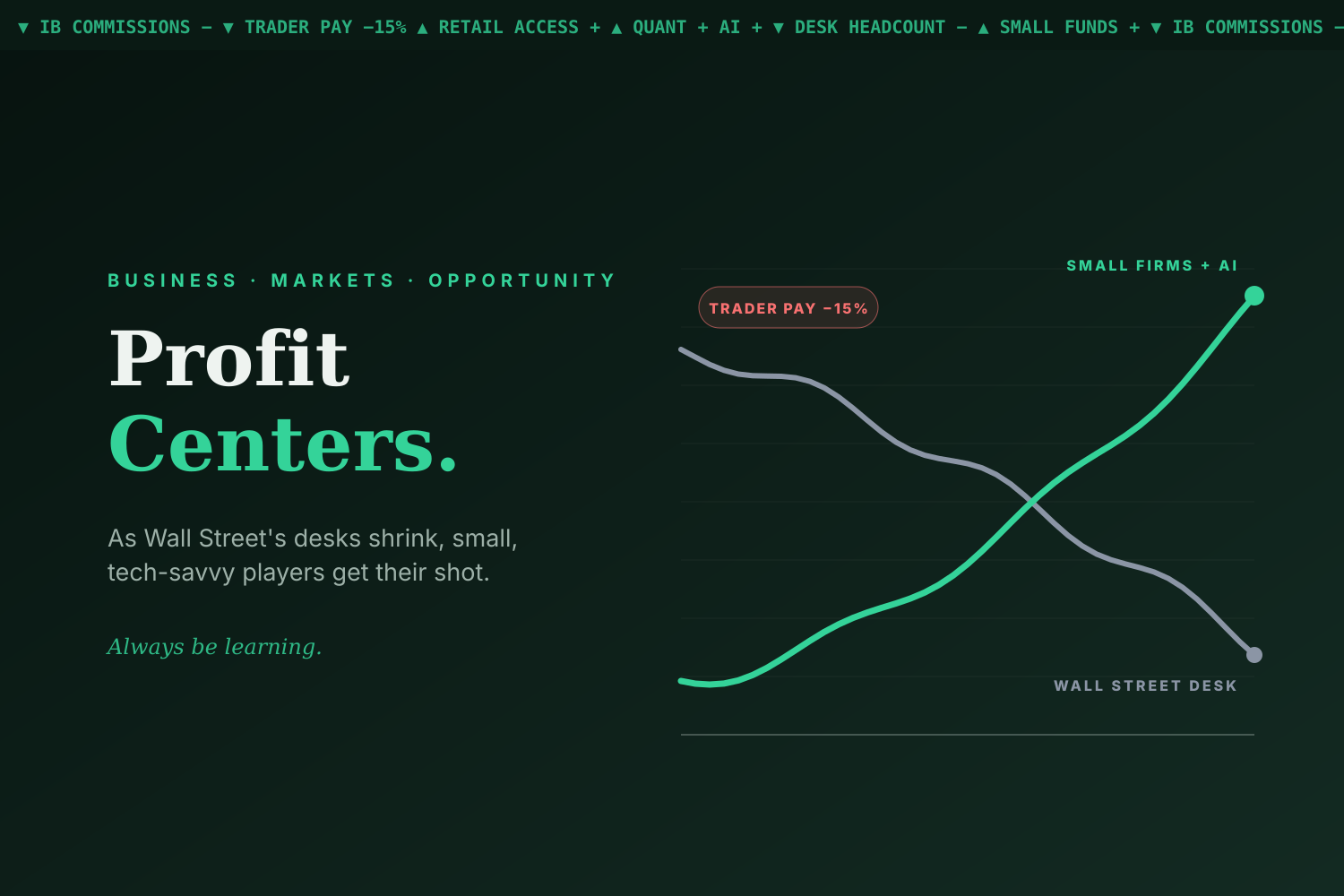
My conclusion back then: retail traders and small, nimble hedge funds without public shareholders breathing down their necks had a real shot at beating the big Wall Street desks. And small entrepreneurs around the world working on artificial intelligence and quantitative analysis were building a smart business model.
Knowledge leads to profits, usually after a bunch of learning experiences. Always be learning. That was my mantra then, and it still is.
What Actually Happened
Here’s the honest update. I got part of this right and part of it very wrong.
Wrong: Trading Profits Didn’t Decline
The big banks’ trading businesses didn’t fade away. In 2026, they’re having their best years ever. The six largest U.S. banks pulled in close to $50 billion of trading revenue in the first quarter alone, a record. Then the second quarter got even bigger, led by a surge in stock trading tied to the AI boom. Goldman Sachs posted record equities trading revenue of $7.42 billion for the quarter, up 72% from a year earlier.
The profits also concentrated at the very top. Goldman Sachs, JPMorgan, and Morgan Stanley have captured the lion’s share of the industry’s equity trading revenue. Scale won. The biggest players got bigger.
Right: The People Got Squeezed
Here’s where my instinct held up. The profit center didn’t shrink, but it moved, away from people and toward technology and balance sheets.
In the first quarter of 2026, the six largest U.S. banks earned about $47 billion in profit while shedding roughly 15,000 jobs, and CEOs openly credited AI for the cuts. In the second quarter, five major banks cut more than 10,000 more jobs, in the same quarter they posted record trading revenue.
Record profits and pink slips at the same time. That’s the clearest sign yet that the profit center has shifted from human labor to machines.
What Happened to Retail Traders
The retail side changed dramatically too. In 2019, the big online brokers dropped trading commissions to zero. Apps made trading feel like a game. Then came the 2021 meme stock frenzy, options trading by everyday investors exploded, and retail became a real force in the market.
But did retail traders beat the professionals, like I predicted? Mostly, no. Study after study has found that the large majority of active day traders lose money over time. Free trading made it cheaper to trade, but not easier to win. The pros still have better data, faster execution, and far more capital.
The everyday investors who did well were mostly the boring ones: buying broad index funds, holding for years, and ignoring the noise.
The Real Lessons About Profit Centers
Looking back, this was never really about Wall Street. It’s about how profit moves in any industry. Here’s what I’ve learned:
- Profit centers move. They rarely disappear. The money in trading didn’t vanish. It moved to whoever had the scale, the technology, and the capital.
- Technology captures the margin. When a task can be automated, the profit flows to whoever owns the automation, not to the people who used to do the task.
- Scale wins commodity games. If you’re competing on the same information and the same product, the biggest player usually wins.
- Small players win with specialization. Retail traders mostly lost by playing the big banks’ game. Small businesses win by picking a niche the giants ignore.
- Your career is a profit center too. If your work can be easily automated, your pay is at risk. If your work combines judgment, relationships, and technology, you’re the one capturing value.
Where I See Opportunity Today
My 2018 hunch about small entrepreneurs using AI turned out to be the part I’d double down on, just not in day trading.
AI tools that would have cost a bank millions to build a few years ago are now available to a one-person business for a monthly subscription. In my own marketing work, AI helps me analyze campaigns, produce creative, and serve clients faster than a much bigger team could a decade ago.
That’s the real leveling of the playing field. Not beating Goldman Sachs at trading, but using the same kind of technology to build a lean, profitable business of your own.
- Own the automation. Learn to use AI tools in your field before someone else uses them to replace you.
- Pair tech with trust. Machines can crunch numbers, but clients still hire people they trust.
- Invest like an owner. If the big banks are capturing record profits, owning a broad slice of the market through index funds lets you share in it.
- Keep learning. Profit centers keep moving. The people who keep learning are the ones who move with them.
The Bottom Line
In 2018, I thought Wall Street’s profit centers were dying. In 2026, they’re bigger than ever, but they belong to fewer people and more machines.
The lesson isn’t to fight the giants on their turf. It’s to watch where the money is moving, position yourself on the right side of it, and always be learning.
Leave a Reply