I once read that for an investment to be a real one, it has to hurt a little when you make it. That’s how you know it mattered.
Building a brand is that kind of investment. It takes time, money, and creative energy, and the payoff doesn’t always show up on next month’s report. But a strong brand is one of the most valuable assets a business can own.
Creative entrepreneurs operate on an energetic principle. The energy you put into your brand is the energy people feel when they find you.
Step Outside Your Own Brand
When it comes to marketing a brand, you need to step outside your organization for a fresh perspective. It’s hard to see your own brand clearly when you’re inside it every day.
Ask yourself the questions a stranger would ask:
- What does this company actually do?
- Why should I care?
- Why should I pick them over the other options?
- Do I trust them?
If you can’t answer those clearly in a few seconds, your prospects can’t either.
Your Brand Is a Platform
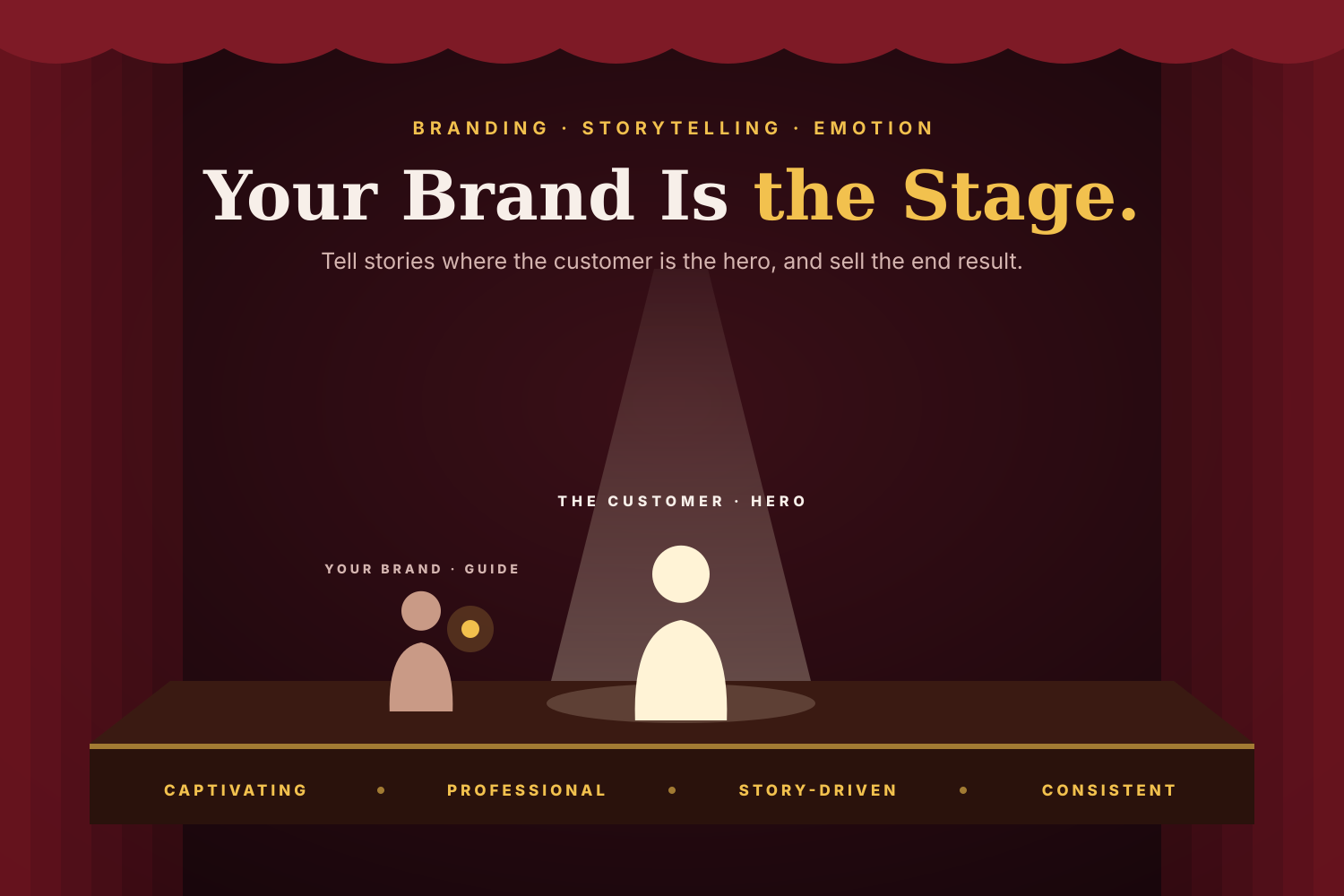
Think of your brand as a platform, not a logo. It’s the stage everything else stands on: your website, ads, social content, emails, customer service, and even the way you answer the phone.
A great brand platform is:
- Captivating: it grabs attention and makes people want to learn more.
- Professional: it signals quality and builds trust.
- Story-driven: it tells people who you are and why you exist.
- Consistent: it looks, sounds, and feels the same everywhere.
And don’t cast it in iron. Think of your brand as something you design and keep refining, not something you set once and never touch again. The best brands evolve with their customers while staying true to their core.
Tell Stories
If a business wants its brand to grow and make more money, its marketing has to tell stories. Stories explain the brand, demonstrate it, and make it memorable.
One of the most useful frameworks I’ve come across is from Donald Miller’s Building a StoryBrand. His big idea: your customer is the hero of the story, not your company. Your brand is the guide that helps them win.
So instead of “We’re the best agency in Denver,” the story becomes “You’re a business owner tired of wasting money on ads that don’t work. We help you turn ad spend into real customers.” Same company, totally different impact.
Great brand stories often come from:
- Customer transformations and results
- The founder’s why
- Behind-the-scenes looks at how the product or service is made
- The problem you exist to solve, and the people you solve it for
Elicit Emotion
We live in a busy, “all business” world. People are bombarded with ads, emails, and content all day long. To cut through the noise, your marketing needs to make people feel something.
Relief, excitement, hope, pride, curiosity, even a little fear of missing out. Emotion is what makes someone stop scrolling and pay attention to your offer. People decide with emotion and justify with logic. The facts still matter, but they come second. Lead with how your product or service will make someone feel, then back it up with the proof that makes the decision feel smart.
Sell the End Result
Position your messaging around one question: what end result will the prospect get?
That’s what you’re really selling, because the end result is what matters to them. Focus on benefits, not features. There’s an old marketing line, often credited to Harvard professor Theodore Levitt: people don’t want a quarter-inch drill, they want a quarter-inch hole.
- Feature: “Advanced audience targeting.” Benefit: “More customers for the same ad budget.”
- Feature: “Weekly reporting.” Benefit: “You always know exactly where your money is going.”
- Feature: “A duplex with two units.” Benefit: “Live for nearly free while building wealth.”
Make the Offer at the Right Moment
There’s a moment when a prospect goes from “not interested” to “interested.” That’s the optimal spot to place a value offer.
Push the sale too early, and you scare people off. Wait too long, and they move on. The trick is to build enough interest and trust with your brand story, then put a clear, valuable next step in front of them right when curiosity peaks. That might be a free audit, a consultation, a sample, or a limited-time deal.
Measuring Your Brand
Brand is harder to measure than a click or a sale, but it isn’t invisible. A few signals I watch:
- Branded search: are more people searching for your company by name?
- Direct traffic: are more people typing your website straight into their browser?
- Referrals and word of mouth: are new customers saying a friend sent them?
- Reviews and mentions: what are people saying about you when you’re not in the room?
- Ad efficiency over time: do your ads get cheaper and convert better as more people recognize you?
When those numbers trend up, your brand investment is working, even if no single campaign gets the credit.
Branding in 2026
Branding has become even more important:
- AI content is everywhere. Anyone can now produce endless generic content. That makes a real voice, real stories, and real personality stand out more than ever.
- People buy from people. Founder-led content and real faces often outperform polished corporate ads, especially on short-form video.
- Brand powers performance. In paid ads, a known, trusted brand usually gets higher click-through rates and lower costs. Marketing researchers Les Binet and Peter Field famously found that long-term brand building and short-term sales activation work best together.
- AI search favors trusted brands. When AI tools answer questions, they tend to cite sources with strong reputations. Brand is now part of how you get found.
The Bottom Line
Step outside your brand to see it clearly. Treat it as a platform. Tell stories where the customer is the hero. Make people feel something. Sell the result, not the features. And put your offer in front of people right when they lean in.
Building a brand will cost you something. That’s how you know it’s a real investment.
Leave a Reply