“Your life is being lived, rather than you living your life.”Unknown
That quote stopped me cold the first time I read it. How much of what we do every day is actually a choice? And how much is just programming running in the background?
The Programming Years
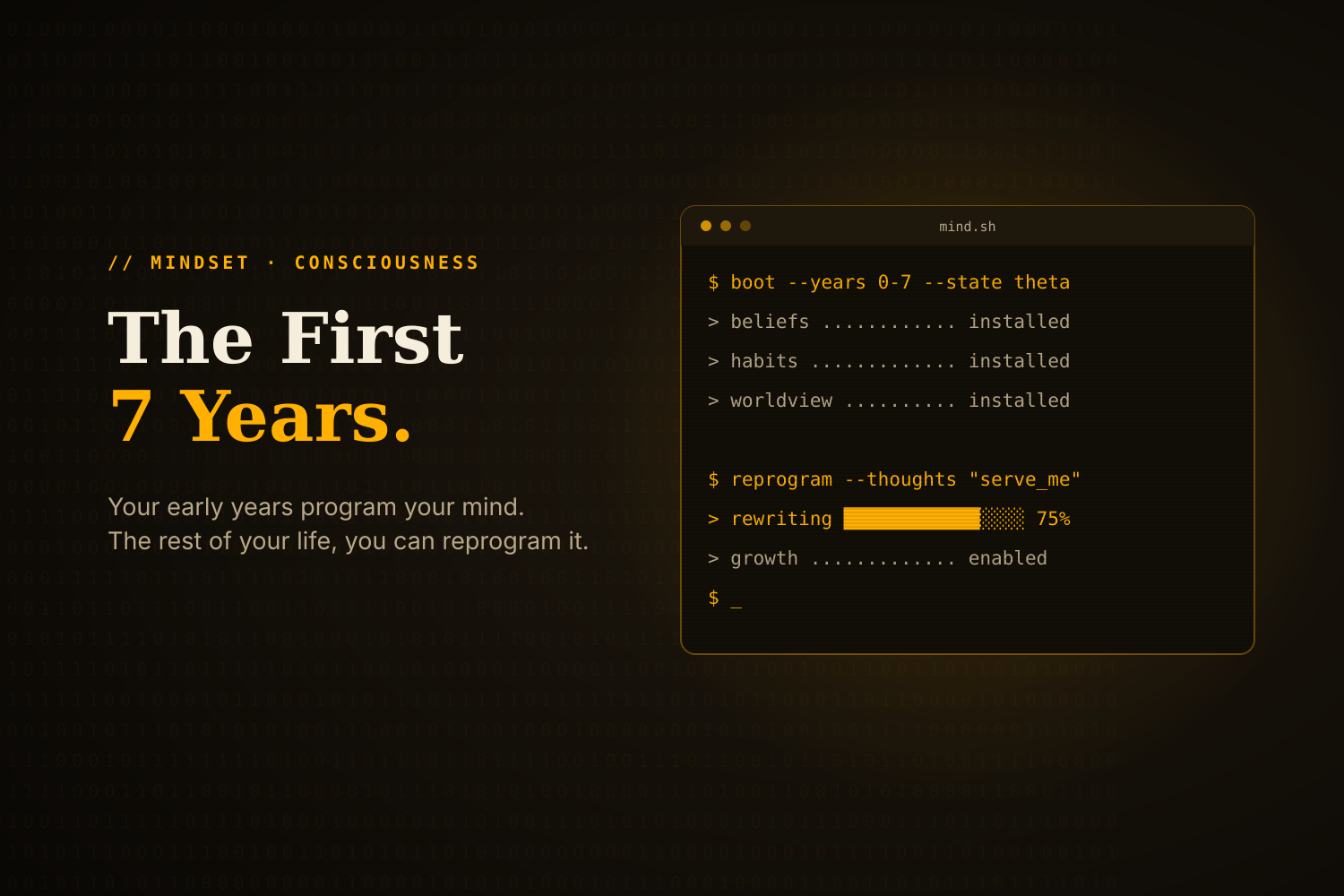
Cell biologist Bruce Lipton, author of The Biology of Belief, popularized the idea that the first 7 years of a person’s life are when the mind gets programmed.
According to Lipton, young children spend much of their time in slower brainwave states, especially theta, which is also associated with deep relaxation and hypnosis. In that state, a child absorbs the world around them like a sponge, without the filters an adult has. They learn how the world works by watching and copying the people around them, long before they can question any of it.
You can’t understand how something works without principles, and these early years are when a child picks up the principles that make their world go round:
- What money is, and whether there’s enough of it
- Whether the world is safe or scary
- How people treat each other
- Whether they’re capable and worthy
- What “success” and “failure” look like
Scientists still debate how literally to take the “hypnosis” part. But the bigger point is widely accepted: early childhood is a period of rapid brain development, and the beliefs and habits formed then can shape us for decades.
Programmed for Better or Worse
Some kids get programmed with empowering beliefs. Others get programmed with limiting ones. Most of us got a mix.
Either way, every person absorbs a huge amount of their default programming in those first years. A child who hears “money doesn’t grow on trees” and “rich people are greedy” on repeat may grow up with a very different relationship with money than a child who watches their parents invest, build a business, or talk openly about finances.
I think about this a lot when it comes to money. I didn’t grow up around investing or wealth building. A lot of what I believed about money early on, I had to unlearn later as an adult.
The Good News: You Can Reprogram
Here’s the powerful part. Your early programming isn’t a life sentence.
Neuroscience has shown that the brain stays “plastic” throughout life. It keeps forming new connections and rewiring old ones based on what we repeatedly think and do. That means you can reprogram your mind into the 1s and 0s you actually agree with. Beliefs that serve you, improve you, and push you forward, instead of the ones that hold you back.
Think the thoughts you want to think. Notice and let go of the thoughts you don’t want.
It’s that simple, and that’s exactly why it’s a secret to living a high lifestyle quotient (LQ) life. Simple works. People like and reward simplicity, and we tend to tune out the ones who overcomplicate things. #KISS
Simple doesn’t mean easy, though. Old programming has had decades of practice. New programming needs repetition, patience, and a little grace with yourself when the old patterns sneak back in.
How I Work on Reprogramming
Here are the tools that have helped me the most:
- Awareness. You can’t change a belief you don’t notice. Start catching the automatic thoughts, especially the negative ones.
- Meditation. Meditation creates space between a thought and your reaction to it. In that space, you get to choose.
- Journaling. Writing down your beliefs about money, work, and yourself makes the hidden programming visible.
- Questioning. Ask, “Is this actually true? Where did I learn this? Does it serve me?”
- New inputs. Books, podcasts, mentors, and communities that model the beliefs you want to adopt.
- Repetition and action. Act on the new belief, over and over, until it becomes the default.
- Environment. Spend time around people who already think the way you want to think.
Therapists use a similar idea in cognitive behavioral therapy: identify unhelpful thought patterns, challenge them, and replace them with more accurate and helpful ones. It works because the brain learns from repetition.
Money Programs Worth Rewriting
Since this blog is so focused on money, here are a few common money beliefs people pick up as kids, and the rewrites that have helped me:
- Old: “Money is the root of all evil.” New: Money is a tool. It amplifies whoever is holding it.
- Old: “Rich people are greedy.” New: Many wealthy people built something valuable that solved problems for others.
- Old: “We can’t afford that.” New: How could we afford that?
- Old: “Debt is always bad.” New: Debt for consumption hurts. Debt for income-producing assets can build wealth.
- Old: “Get a safe job and retire at 65.” New: Build assets so work becomes optional, sooner.
Show Me the Child
There’s an old saying, often attributed to the Jesuits: “Give me the child until he is seven, and I will show you the man.”
There’s truth in it. If a person never works on their consciousness through learning, new experiences, meditation, or reflection, they’ll likely stay the same person their whole life, running the same programs they picked up as a kid. That’s a shame.
But it’s not destiny. The saying describes what happens by default. Growth is what happens on purpose, one decision at a time.
A Note for Parents
If the first 7 years matter this much, parents have an incredible opportunity. Kids are watching everything: how you talk about money, how you handle stress, how you treat other people, and how you talk about yourself.
You don’t have to be perfect. Just be intentional. Model the beliefs and habits you’d want your kids to carry with them for the rest of their lives.
A Life of Growth
A good life is one of growth and improvement, not stagnation. You didn’t get to choose your first 7 years. You do get to choose the next 7, and every 7 after that.
So take a look at your programming. Keep what serves you. Rewrite what doesn’t. And start living your life, instead of letting it be lived for you.
Leave a Reply