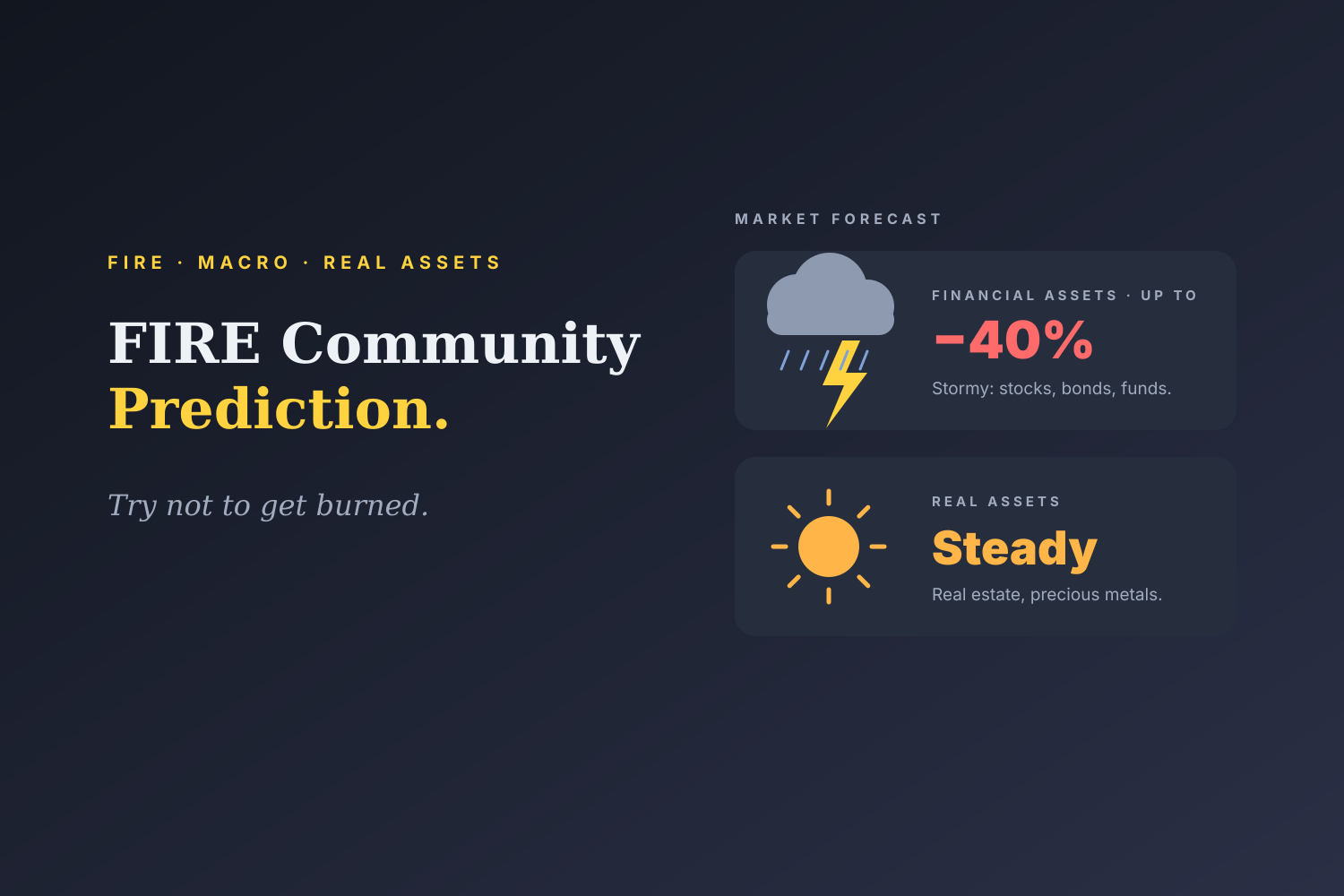
Try not to get burned.
I’ve been forming a theory about future events that could seriously hurt early retirees who have most of their wealth in financial assets. I’m sharing it here as a prediction, and I’ll be honest about how it plays out over time.
The Prediction (October 2019)
Here’s the theory.
The Federal Reserve will launch new rounds of quantitative easing (QE) to either stimulate the economy, manipulate it, or both. QE means the Fed creates money and buys bonds and other assets, pushing more cash into the financial system.
That will cause two things:
- Inflation will rise. More money chasing the same goods and services pushes prices up.
- Financial asset prices will inflate. Stocks and bonds will look more valuable on paper, even if the real economy isn’t growing at the same pace.
Neither of these is a true benefit to the economy. They’re a sugar high.
Why FIRE Retirees Could Get Burned
Eventually, I believe the market will correct. When it does, many people in the FIRE community could see their portfolios drop by as much as 40%, as the effects of QE and a general mismanagement of the world economy unwind.
Here’s why that’s dangerous for early retirees. Most FIRE plans lean on the 4% safe withdrawal rate. The rule assumes you withdraw 4% of your portfolio in year one, then adjust for inflation each year after. It was built on historical market data, and it was mostly tested over 30-year retirements, not the 40 to 50 years many early retirees are planning for.
A big crash early in retirement is the worst-case scenario. It’s called sequence of returns risk. If you’re pulling money out while the portfolio is down 40%, you’re selling low and permanently shrinking the base that’s supposed to last the rest of your life.
The result could be:
- A forced cut in lifestyle
- Real fear that the money won’t outlast the investor’s natural life
- A looming need to return to the workforce
The Return to Work
Multiply that story by hundreds of thousands of people, and you get a wave of older, skilled workers re-entering a job market where they haven’t been growing their careers. Many would have to start over at around $50,000 a year.
I can imagine a lot of bitterness in that scenario. The FIRE lifestyle didn’t work out, not because they did anything wrong, but because the macroeconomy didn’t cooperate with their strategy.
Ray Dalio has been warning that the next downturn could be long, painful, and drawn out, and that cash and traditional assets may not protect investors the way they used to. That adds fuel to my belief that real assets are the best strategy going forward.
Put simply: it will be harder to make money in financial assets (stocks, bonds, mutual funds) and easier to make money in real assets (real estate, precious metals).
Looking Back From 2026: How Did I Do?
A prediction is only worth something if you go back and grade it. So here’s my honest report card, about 7 years later, with no excuses.
What I Got Right
- QE came, and it came big. When COVID hit in 2020, the Fed launched the largest round of quantitative easing in history.
- Inflation rose. By mid-2022, U.S. inflation hit its highest level in about 40 years.
- The market crashed. In early 2020, the S&P 500 fell roughly a third in about a month. Then 2022 brought a full bear market of about 25%.
- Real assets did well. Home prices rose sharply in the years after 2019, and gold hit record highs, with an all-time high above $5,600 an ounce in January 2026.
What I Got Wrong
- The crashes didn’t last. The 2020 crash recovered in months, not years. The “long, drawn out” correction never really showed up.
- Financial assets did great. The S&P 500 was around 3,000 when I wrote this. In November 2026, it’s above 7,500. That’s roughly two and a half times higher before dividends.
- The FIRE wave back to work didn’t happen. Most people who stayed invested and kept their withdrawals reasonable came out fine, and many came out well ahead.
The Real Lesson
My mistake wasn’t the economics. It was believing I could predict the timing and choose one winning asset class. Both real assets and financial assets did well. The people who got hurt were mostly the ones who panicked and sold at the bottom.
Today, I don’t think it’s real assets versus financial assets. I own both: rental real estate for cash flow and tax benefits, and broad index funds, both U.S. and international, for simple, diversified growth. Each one covers the other’s weak spots.
I also learned something about my own mindset. In 2019, I was reading a lot of doom-and-gloom macro content, and it shaped how I saw everything. Fear makes for a compelling story, but it’s a terrible investment strategy. Staying consistent, buying assets I understand, and holding them through the noise has done far more for my net worth than any prediction I’ve ever made.
How FIRE Retirees Can Avoid Getting Burned
The risk I described in 2019 is still real. Sequence of returns risk doesn’t go away just because the last crash recovered quickly. Here’s how I’d protect against it:
- Be flexible with withdrawals. Spending less in down years is one of the most powerful protections there is.
- Keep a cash buffer. One to two years of expenses means you don’t have to sell stocks in a crash.
- Diversify across asset types. Stocks, bonds, real estate, and a business can all play a role.
- Keep some income coming in. Part-time work, consulting, or rentals reduce how much you need to pull from the portfolio.
- Use a more conservative rate for a long retirement. Many early retirees plan around 3% to 3.5% instead of 4%.
The bottom line: make predictions, but don’t bet your whole future on them. Build a plan that works whether you’re right or wrong. That’s how you avoid getting burned, no matter what the Fed or the market decides to do next.
Leave a Reply