Ring ring.
I picked up the phone, and within seconds I knew what kind of call it was. The client on the other end was ready to rip me a new one. He wasn’t interested in reasoning with me. He called to yell and let me know exactly how unhappy he was.
If you work with clients long enough, you’ll get this call. Probably more than once or twice. And here’s the truth: trying to negotiate with someone in that mental state is nearly impossible. Logic bounces right off them. Defending yourself only adds fuel.
Luckily, my CEO had given me a simple process for exactly this situation. I used it on that call, and it turned a screaming match into a win. Here it is.
The Notepad Method
The whole thing fits on one sheet of paper. Here’s how the call unfolds, phase by phase.
Phase 1 · The First 10 Seconds: Grab a Pen
As soon as you realize the client is upset, take out a piece of paper (or open a blank doc). Your only job right now is to listen and write. Don’t interrupt. Don’t correct. Don’t explain.
Phase 2 · The Venting: Write Down Every Pain Point
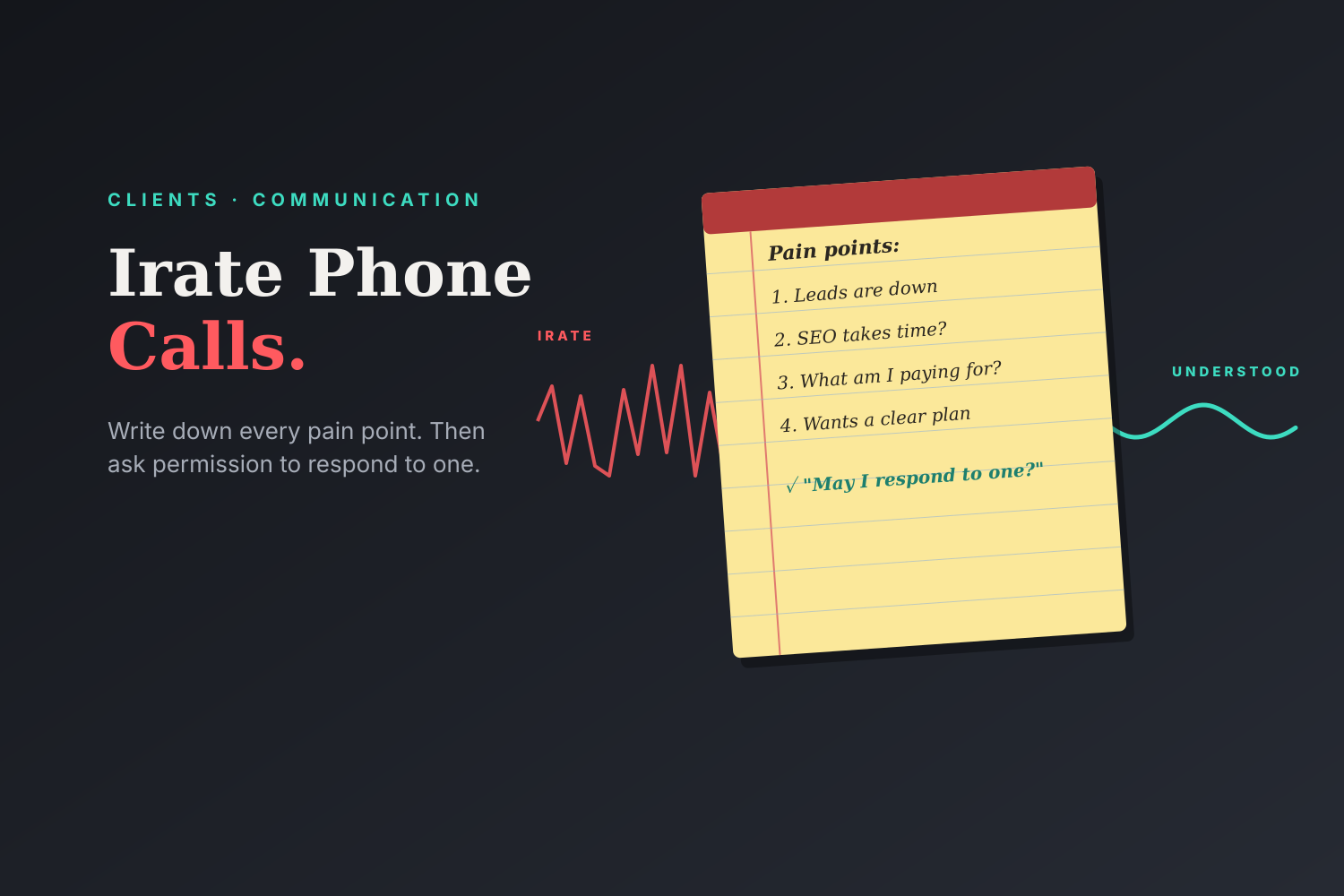
As the client talks, write down each complaint as a separate bullet. Use their words when you can. You’re building a list of everything that’s bothering them.
Something interesting happens here. Writing keeps you calm. Instead of reacting emotionally, your brain is busy organizing. And the client usually starts to slow down once they feel like they’re being heard instead of argued with.
Phase 3 · The Pause: Ask Permission
When they finally finish their story, don’t launch into a defense. Ask permission to respond. Here’s the exact line my CEO taught me:
“Would it be okay if I talked about one of the
concerns I wrote down while you were speaking?”
That one question changes the whole energy of the call. It shows you listened, it gives them control, and it turns a rant into a conversation.
Phase 4 · The Response: One Issue at a Time
Go down your list, one point at a time. Start with the easiest one to resolve, so you build momentum. For each issue:
- Repeat it back in your own words so they know you understood.
- Explain what happened, clearly and simply.
- Say what you’re going to do about it, and when.
Phase 5 · The Close: Confirm and Commit
Before you hang up, summarize the plan and confirm they’re on board:
“So here’s what I’ve got: we’ll fix X by Friday,
I’ll walk you through Y on our next call, and I’ll
send you a recap email today. Does that sound right?”
How My Call Actually Went
I followed the process step by step. I took good notes on every issue he raised. By the time he finished, it was clear that most of his frustration came from a misunderstanding about how online marketing actually works. He expected things to happen faster and differently than they realistically could.
Once I walked through each concern one at a time, the temperature dropped. By the end, he felt completely understood and confident about where things were headed. The call that started with yelling ended as a success. Nice!
Why It Works
Former FBI hostage negotiator Chris Voss, author of Never Split the Difference, teaches a similar idea. People need to feel heard before they can think clearly. When you label and repeat back someone’s concerns, their emotions calm down and the logical part of their brain comes back online.
The notepad method does exactly that. Listening first earns you the right to be heard second.
Do This, Not That
✔ Do:
- Stay calm and keep your voice steady
- Let them finish completely
- Take notes on every complaint
- Own any mistakes that are actually yours
- Follow up in writing the same day
✘ Don’t:
- Interrupt or talk over them
- Get defensive or blame the client
- Make promises you can’t keep just to end the call
- Take it personally
- Let it fester by not following up
After the Call: The Recap Email
Always send a short recap the same day. It shows you took the call seriously and gives you both a record of the plan. Something like this:
Hi [Name],

Thanks for taking the time to walk me through your
concerns today. Here’s what I heard and what we’re doing:

1. [Concern] → [Action] by [Date]
2. [Concern] → [Action] by [Date]
3. [Concern] → [Action] by [Date]

I’ll check in on [Date] with an update. If I missed
anything, just reply and let me know.

Kyle
When the Anger Shows Up in Writing
These days, a lot of upset clients don’t call. They fire off a long email, a Slack message in all caps, or a text late at night. The same method still works, with a few tweaks:
- Don’t reply right away. Read it, step away for a few minutes, and let your own emotions settle.
- Make your list. Pull every complaint out of the message and write it down, just like on a call.
- Acknowledge fast. Send a short reply letting them know you got it and you’re on it.
- Move it to a call. Tone gets lost in text. A quick phone or video call resolves things much faster than a long email thread.
- Recap in writing. After the call, send the same recap email so everything is documented.
The golden rule: never argue in writing. Written arguments last forever and almost always escalate.
Prevent the Next One
Most irate calls start long before the phone rings. Often, it’s a gap between what the client expected and what actually happened. A few habits cut down on these calls a lot:
- Set clear expectations at kickoff about timelines and results
- Explain how the work actually works, in plain language
- Share bad news before the client discovers it
- Keep a regular check-in rhythm so nothing builds up
Upset clients aren’t the end of the world. Handled well, they’re often the start of a stronger relationship. Grab a pen, listen hard, and let your notes do the talking for you.
Leave a Reply