Back in 2018, I wrote about how finding the right audience turned around a struggling account. Interest targeting, lookalikes from a strong email list, lookalikes from social followers. We hit a 5% click-through rate and felt like geniuses.
That playbook worked. It doesn’t work the same way anymore.
I spend most of my working hours inside Meta Ads Manager, and the platform I log into today barely resembles the one I learned on. Here’s what changed, why it changed, and what I’m doing about it.
What Broke the Old Playbook
1. Privacy Changed the Data
In 2021, Apple rolled out App Tracking Transparency. Every iPhone user got a pop-up asking if they wanted apps to track them, and most people said no.
Overnight, platforms like Meta lost a huge amount of visibility into what people did after they clicked an ad. Conversions went missing. Audiences shrank. Retargeting pools got smaller. A lot of advertisers panicked, and plenty of accounts never fully recovered.
2. The Machine Got Smarter
Meta’s answer was to lean harder on machine learning. If it couldn’t follow people around the internet as easily, it would get better at predicting who was likely to buy.
Advantage+ campaigns automated more and more of the setup. Then came Andromeda, Meta’s newer ad retrieval system, which decides which ads are even eligible to be shown to each person before the auction happens. Today, Advantage+ is the default for new campaigns, and the detailed targeting you select is treated more like a suggestion than a fence.
Translation: the algorithm wants to pick the audience. Your job is to give it the right ingredients.
Detailed Targeting Matters Less Now
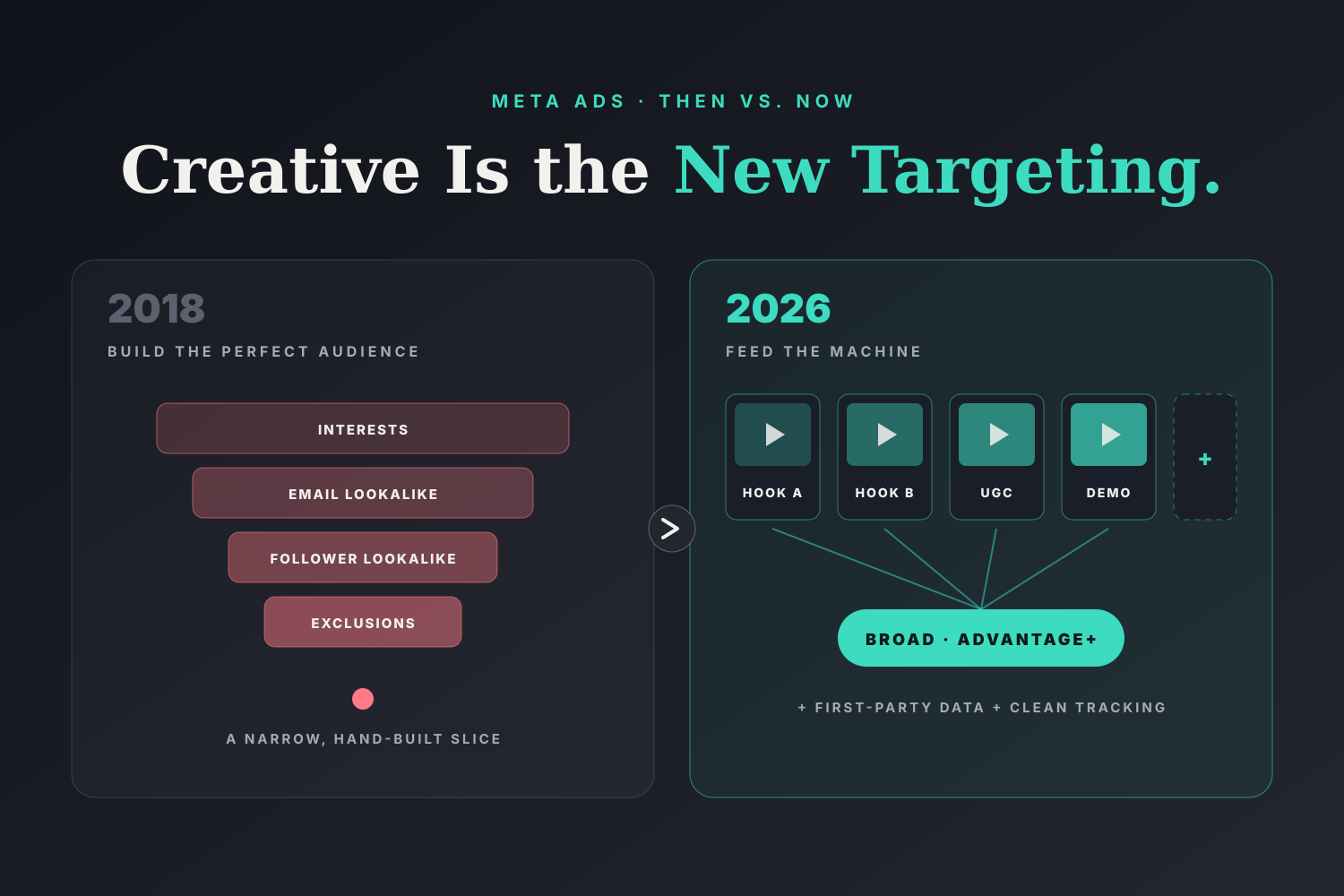
In 2018, the skill was building the perfect audience. Stack the right interests, layer the right lookalikes, exclude the right people, and you won.
In 2026, tight audience stacks often hold performance back. Narrow targeting limits how much data the system can learn from and how many people it can test your ads on. In most of the accounts I run, broad targeting with strong creative beats a carefully built interest stack.
That was a humbling shift for me. A lot of my early wins came from audience work. But humility beats ego, and the data is pretty clear. So here’s what matters more now.
Creative Is the New Targeting
This is the big one. The ad itself now tells the algorithm who to show it to.
A video of a single mom talking about getting approved for a car loan will find a different audience than a slick product shot with a price on it. A yoga ad focused on stress relief will reach different people than one focused on flexibility. Every hook, angle, format, and face in your ad is a targeting signal.
That changes how you build a campaign:
- Think in angles, not audiences. Instead of “women 25 to 44 interested in fitness,” think “the busy professional who needs 20 minutes of calm” and “the beginner who’s intimidated by a class.”
- Make creative that’s actually different. Changing the headline on the same image isn’t a new ad. Meta tends to treat near-identical ads as the same thing. Different hooks, formats, people, and messages give the system more ways to find a match.
- Feed the machine consistently. Creative fatigues faster than it used to. I plan new concepts every week or two, not just when performance drops.
- Let the data pick the winners. Launch several distinct concepts, give them time to learn, and put budget behind what the numbers support, not what you personally like best.
The creative brief has basically become the targeting setup. If your ads aren’t working, the problem is usually the creative, not the settings.
First-Party Data Is Gold
Some things from 2018 held up. My old account had a strong email list, and that list was the secret sauce behind our best lookalikes.
That’s even more true today. With less tracking data floating around, the data you own is one of the most valuable signals you can give a platform:
- Customer purchase lists
- Email subscribers
- Qualified leads from your CRM
- High-value customers, ideally separated from one-time buyers
Garbage in, garbage out. Gold in, gold out. A list of your best repeat customers tells the algorithm far more than a list of everyone who ever visited your homepage.
If you run a business and you aren’t collecting emails and tracking who your best customers are, start now. It’s an asset that gets more valuable every year.
Clean Tracking Is Essential
If creative is the steering wheel, tracking is the GPS. The algorithm optimizes toward whatever results you report back to it. If your tracking is broken or incomplete, you’re teaching the machine the wrong lessons.
Browser-based tracking alone misses a lot of conversions now. That’s why server-side tracking, like Meta’s Conversions API, has become a must. It sends conversion data straight from your website or CRM to Meta, so fewer sales and leads slip through the cracks.
A few habits that have saved me a lot of headaches:
- Audit tracking before you spend. Test every form, checkout, and thank-you page.
- Optimize for the result that matters. A qualified lead or a purchase beats a cheap click every time.
- Send back quality signals. When a lead turns into a real customer, feed that back to the platform if you can.
- Check the platform against reality. Compare what Meta reports to what actually shows up in the bank account or CRM.
Some of the biggest performance jumps I’ve seen didn’t come from a new ad. They came from fixing tracking so the algorithm could finally see what was working.
How I Set Up Campaigns Today
Every account is different, but my starting point usually looks like this:
- Simple campaign structure with fewer, larger ad sets so the system gets enough data to learn
- Broad or Advantage+ audiences as the default
- A steady pipeline of distinct creative concepts
- Server-side tracking and clean conversion events from day one
- Customer lists uploaded and kept fresh
- Weekly reviews focused on real business results, not vanity metrics
The Fundamentals Never Change
Here’s what I find funny. The tools changed completely, but the core lesson from that 2018 account still holds: reach the right people, let the data guide you, and stay humble enough to change course when the numbers tell you to.
Back then, I reached the right people by building audiences. Today, I reach them by building the right ads and feeding the machine clean data. Same goal, different route.
The platforms will keep changing. There will be another update next year that makes this post feel dated too. But the fundamentals of knowing your customer, speaking directly to their problems, and following the data never go out of style.
Leave a Reply