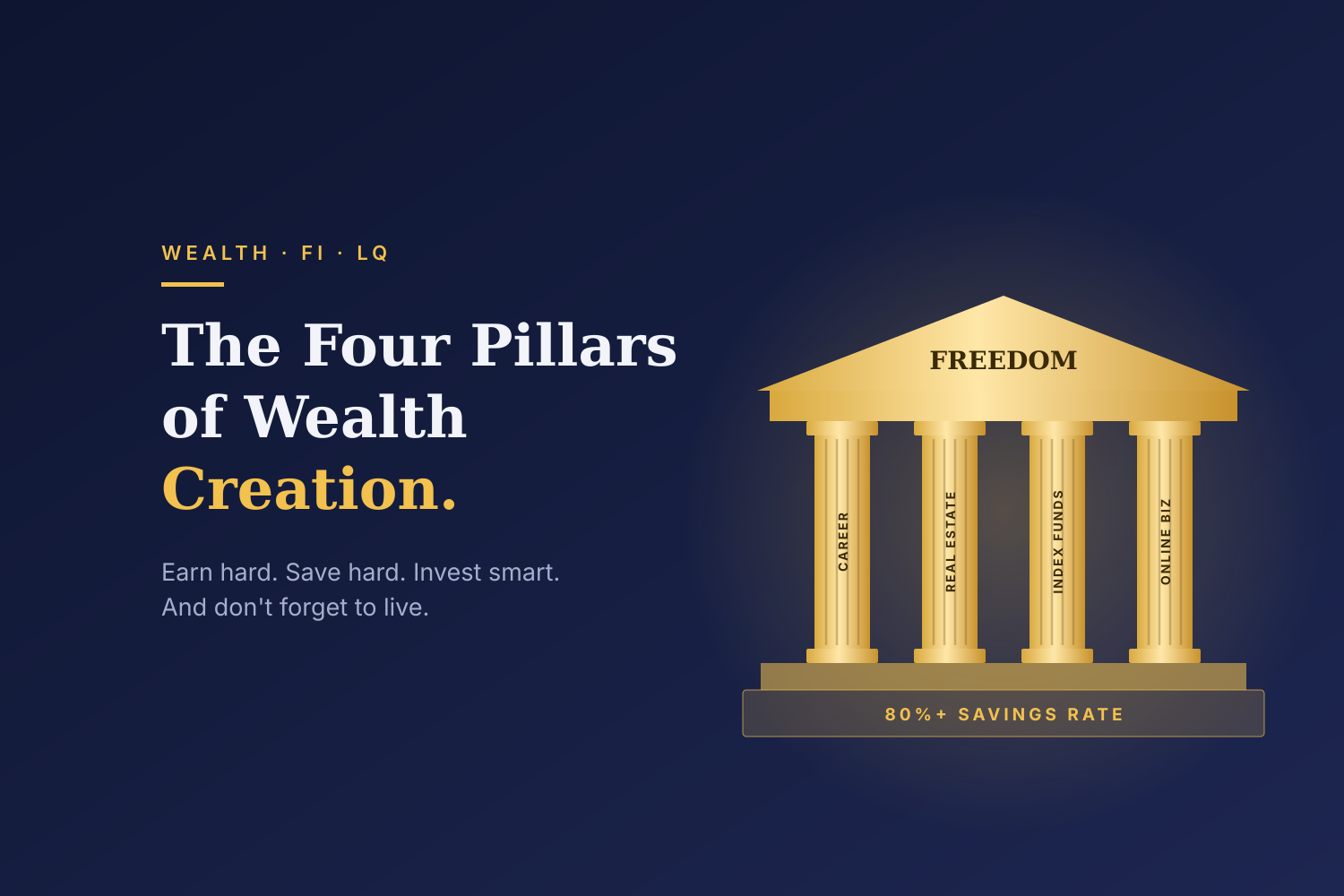
Here are my wealth creation principles, the framework I use to build wealth without giving up the best years of my life.
The Four Pillars of Wealth Creation
- Career: merit- and performance-based.
- Real estate: good location, good infrastructure, cash flow.
- Stocks and bonds: index funds.
- Online business: subscription-based and scalable through technology.
Here’s why each one matters:
- Career is the fuel. A merit-based career (sales, commissions, results-driven roles) has no income ceiling. Hourly and salaried jobs do. You need a big income engine to fund everything else.
- Real estate is the foundation. It cash flows, it’s leveraged with the bank’s money, and it comes with tax advantages. Location and infrastructure matter because people want to live where the jobs, roads, and amenities are.
- Index funds are the autopilot. Low cost, broadly diversified, and zero effort. Set it, forget it, and let compounding work for decades.
- Online business is the multiplier. Subscription revenue is predictable, and technology lets you serve 10 customers or 10,000 with almost the same effort. That’s where the upside gets unlimited.
The Implied Pillar: Your Savings Rate
Underneath all four pillars is one non-negotiable: a high savings rate. I aim for 80% or more. Without saved capital, you’re fucked. You might as well give up before you start.
How is that even possible? House hacking. When tenants cover your housing, your biggest expense disappears, and a huge chunk of your paycheck is suddenly free to invest. That’s the cheat code.
But Don’t Forget to Live
You only live once. Physically, your 20s and 30s are the best years of your life. Giving up snowboarding, music festivals, Boosted Board adventures, and the like means giving up on life far too early.
The FIRE community is wise to save all it can. But saving at the expense of any happy lifestyle is a fool’s errand. If a frugal mindset overrules every single daily decision, you’ll lose both the economic battle and the LQ battle over the course of your life.
What Is LQ?
Let’s define LQ, because this concept is critical for a happy, fulfilled, dynamic life.
LQ = Lifestyle Quotient. It’s a measure of how much time, freedom, and joy your life actually has. Not how much money you make. How well you live.
High-LQ signs look like:
- You control your calendar more than your boss does
- You can travel without asking permission
- You spend real time on your health, hobbies, and people you love
- Your money supports your life instead of running it
Someone earning $300K but working 80-hour weeks in a city they hate has a low LQ. Someone earning $80K with paid-off rentals, three months a year of travel, and a powder day whenever it snows has a high LQ. I know which one I’d choose.
IQ vs. EQ
My whole life, IQ (intelligence quotient) has been all the rage. From SAT and ACT scores to GPAs in college, it seems like intelligence is the predominant factor in a successful life.
As my career progresses, I find IQ isn’t as important as I once believed. Quite the opposite, actually. In a business career working with people, EQ (emotional quotient) matters more than IQ. It’s not how smart you are. It’s how good you make people feel.
When the people working on your accounts feel good, they work harder, more diligently, and with more dedication, and your accounts perform better. This is very good!!
The Skills That Actually Matter
Beyond emotional intelligence, a few other skills are major factors in winning the game of life:
- Business skills
- Work ethic
- Curiosity
- Integrity
- Ruthlessness
What school on this planet teaches these things? The internet. That’s it.
Think about that. The internet has all of life’s most worthwhile lessons and classes. Not public education. Not college, with its criminally high tuition, plus interest on the loans, crippling most young people.
Where to Learn It for (Almost) Free
- Podcasts: BiggerPockets for real estate, plus business and marketing shows for your commute and workouts.
- Books: Set for Life, Rich Dad Poor Dad, and anything on sales and negotiation. Library cards are free.
- YouTube: Want to learn how to analyze a rental, run Google Ads, or install LVP flooring? It’s all there.
- Online communities: Forums and groups full of people a few steps ahead of you who love answering questions.
- Doing it: The best teacher is still a real deal, a real client, and real money on the line.
The 10 to 15 Year Plan
If you want to build true wealth, focus on a merit-based career and invest the proceeds in real estate, stocks, bonds, and online businesses.
Done diligently, with a well-thought-out purpose and goals you chose yourself, an investor can reach financial freedom in 10 to 15 years. Roughly:
- Years 1 to 3: Build your career, nail your defense, buy your first house hack.
- Years 4 to 8: Add a property every year or so, max out index funds, push your income higher.
- Years 9 to 15: Let compounding take over, build or buy an online business, and watch your cash flow cover more and more of your life.
Earn hard. Save hard. Invest smart. And don’t forget to live along the way.
Leave a Reply