Let’s talk about fixed income, the Federal Reserve, and why I’m positioned the way I am right now.
What Is Fixed Income?
Fixed income investments pay you regular income at a rate you know ahead of time. You lend your money, and in return you get predictable interest payments, then your principal back at the end.
The most common types are:
- Treasury bonds and bills: loans to the U.S. government, considered the safest in the world.
- Corporate bonds: loans to companies, usually paying more than Treasuries in exchange for more risk.
- Certificates of deposit (CDs): bank deposits locked up for a set time at a set rate.
- Preferred stock: a hybrid that pays a fixed dividend and sits ahead of common stock if a company runs into trouble.
Fixed income is the “steady” part of a portfolio. It won’t make you rich, but it can protect you, smooth out the ride, and give you cash to use when opportunities show up.
Why My Fixed Income Is So Low (2018)
So why are my fixed income positions sitting at a remarkably low level? Because I’m young, and I have time.
A traditional rule of thumb says your bond allocation should roughly match your age. At my age, that would still leave the large majority of my money in growth assets. With decades ahead of me, I can ride out the ups and downs of stocks and real estate in exchange for higher long-term returns.
I also think the stock market, specifically the S&P 500, is inflated after the Federal Reserve’s three rounds of quantitative easing following the 2008 financial crisis. When the Fed pumps that much money into the system, asset prices tend to rise faster than the real economy.
Cheap Money, Scary Cheap
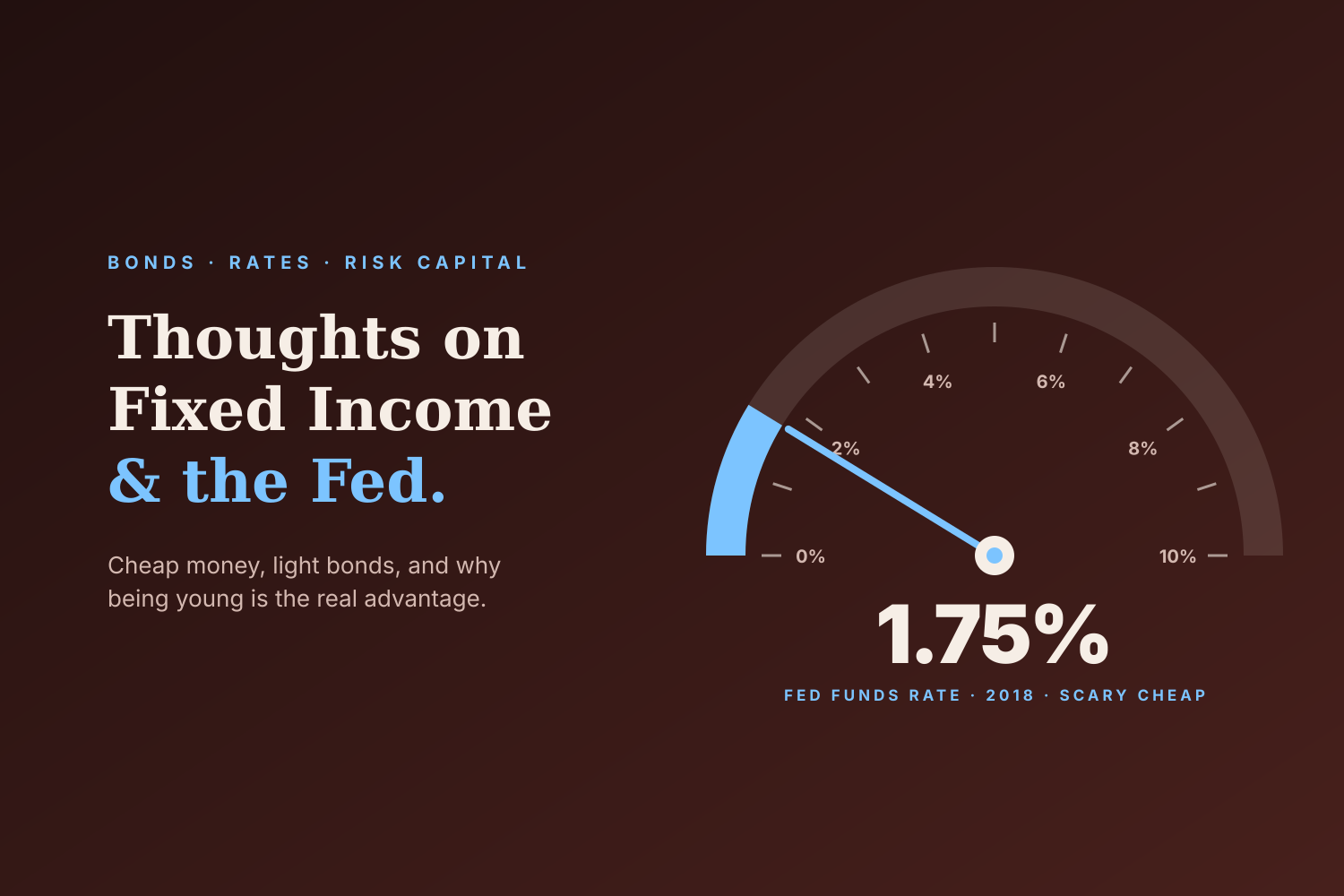
Right now, the Fed’s target for the federal funds rate is 1.50% to 1.75%. That’s the rate banks charge each other for overnight loans, and it influences almost every other rate in the economy, from credit cards to mortgages.
The cost to borrow money is cheap. Scary cheap.
That’s one of the big reasons I bought a duplex in Northern Colorado in my mid-20s. When rates are this low, a fixed-rate mortgage on an income-producing property is one of the best deals out there. You lock in today’s cheap money for 30 years, and your tenants help pay it back with dollars that will likely be worth less over time because of inflation.
Cheap money won’t last forever. When the Fed raises rates, borrowing gets more expensive, and the window for these kinds of deals starts to close.
How the Fed Touches Your Wallet
Most people tune out when they hear “Federal Reserve,” but its decisions show up in your life constantly:
- Mortgages and car loans: lower rates mean smaller payments and more buying power.
- Savings accounts and CDs: lower rates mean your cash earns almost nothing.
- Stock prices: cheap money tends to push investors toward stocks and other riskier assets, which lifts prices.
- Bond prices: when rates rise, existing bonds lose value, because new bonds pay more.
Understanding this relationship helps you decide when to borrow, when to save, and where to put your money. You don’t have to predict the Fed. You just need to know which way the wind is blowing and position yourself accordingly.
The Power of Youth and Risk Capital
Being young gives you a unique advantage with risk capital. That’s money you can afford to put into higher-risk, higher-reward opportunities. If I fail now, I have plenty of time to recover. That’s why I believe young people should be hustling hard.
Almost everything you’ll read about investing says to start as early as possible, for two reasons:
- You learn faster. Early mistakes are cheaper, and the lessons last a lifetime.
- Your money has more time to grow. Compounding rewards time more than anything else.
There’s more than one reason humans love youth so much.
Start, Then Keep Going
Beyond money, the sooner you start any skill or activity, the sooner you move from beginner to adequate, then to skilled, and eventually to master. Mastery is where the money is.
So what do most people do? They either never start, or they never keep going.
If you can manage both, starting and staying consistent, you’ll win. It really is that simple, even if it isn’t always easy.
Pledge on your soul to honor these two qualities in your work and career: start, and keep going. Do that, and the gates of opportunity can’t help but open. Money, relationships, fine dining, and travel will follow.
Update: How It Played Out
Looking back on this post years later, the world of interest rates looks very different.
- Rates went even lower first. In 2020, the Fed cut rates to near zero and launched another massive round of quantitative easing during COVID. Mortgage rates hit record lows in 2020 and 2021.
- Then they shot up. To fight the inflation that followed, the Fed raised rates faster than it had in decades during 2022 and 2023.
- Today, money isn’t cheap. As of late 2026, the federal funds target range is 3.75% to 4.00%, and mortgage rates are far above where they were when I bought.
Locking in low fixed-rate mortgages during the cheap-money years turned out to be one of the best financial decisions I’ve made. Those rates are locked for the life of the loans, no matter what the Fed does next.
My view on fixed income has also matured. When rates were near zero, bonds and cash paid almost nothing, so keeping very little there made sense. Now that short-term Treasuries pay a real yield again, I keep a meaningful slice in short-term Treasury bills as dry powder. It earns a solid return while it waits, and it’s ready when the next opportunity shows up.
The bigger lesson still stands: start early, keep going, and use each rate environment for what it’s good for. Borrow when money is cheap. Earn on your cash when it isn’t. And never let the Fed’s next move stop you from building.
Leave a Reply