Everyone has an opinion on where you should put your money. On this blog, I focus on the three pillars I’ve found to be the best: the stock market, real estate, and business.
Some people start investing super early in life. They’re way ahead of the curve to reach the stage where they can give back to their communities and live a fuller life. People who start later can absolutely get there too. It’ll just take a little longer, because they’ve lost time, the most important resource.
This post covers a few principles for making money in the stock market. Some of them are counterintuitive. But understanding them should raise your financial IQ, which helps you make smart money decisions, so you’re not forced to work for the rest of your life.
Principle 1: Drops Are Normal, and They’re Coming
Market drops aren’t a sign something is broken. They’re part of the deal. Here’s roughly how often different-sized drops have happened in the S&P 500 historically:
- Pullbacks (5%+): several times most years
- Corrections (10%+): about once every couple of years
- Bear markets (20%+): roughly every 6 to 7 years on average
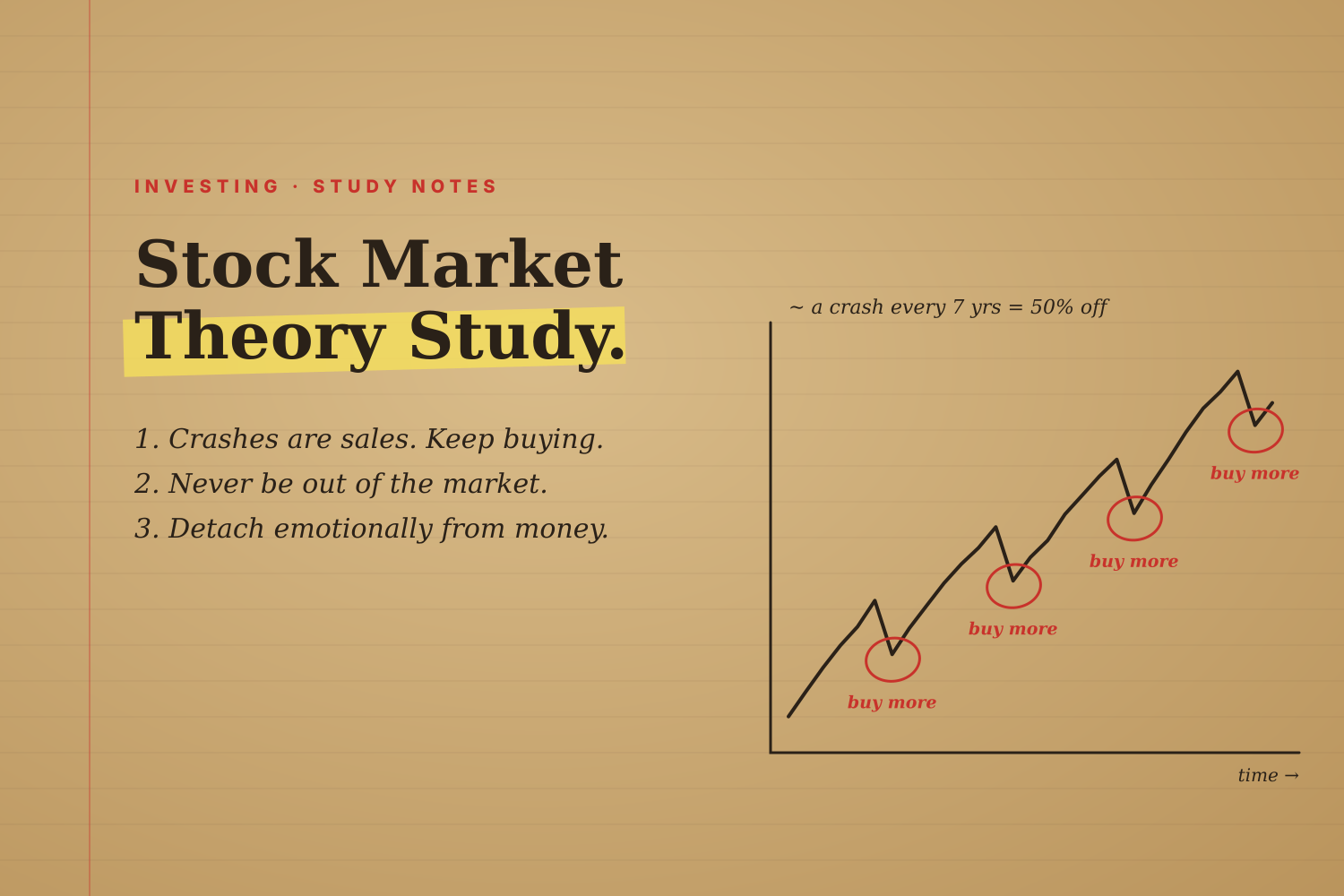
- Crashes (30%+): about once every 7 years or so
The average bear market going back to 1929 has knocked the S&P 500 down nearly 40%. Sometimes stocks get cut close to in half.
Just look at recent history. In the 2008 financial crisis, the S&P 500 fell more than 50% from its peak. In 2020, COVID knocked it down about a third in a single month. In 2022, it dropped roughly 25%. Every single time, it felt like the end of the world. And every single time, the market eventually climbed back to new highs. The investors who kept buying through those drops got some of the best prices of their lifetimes.
If you’re early in your investing career, and not about to retire, that’s a gift. A major crash means everything is on sale. Buy more stocks and ETFs during big market drops, and you’ll ride the recovery further down the line.
Principle 2: The Most Dangerous Place Is Out of the Market
When the market breaks, an incredible opportunity opens up. One of the most dangerous things you can do with money is not be in the market.
Why? Because the best days in the market often come right after the worst ones. People who panic and sell usually sit in cash while the market rebounds without them. Then they buy back in at higher prices. Sell low, buy high. That’s the exact opposite of the goal.
Stay disciplined, keep buying, and let the nest egg grow. Time in the market beats timing the market.
Principle 3: Stop Watching the Scoreboard
Until you have a seven-figure portfolio, you shouldn’t even be looking at it from a trading perspective. Early on, your job isn’t to outsmart the market. Your job is to feed the machine every month.
Here’s the funny thing: early in your investing life, your monthly contributions matter way more than your returns. If you have $10,000 invested and the market drops 20%, you lost $2,000 on paper. If you’re contributing $1,000 a month, you’ll make that back in two months of saving. Your savings rate is the engine. Returns are the turbocharger that kicks in later.
So check your portfolio less. Once a quarter is plenty. Delete the app from your home screen if you have to.
Principle 4: Detach Emotionally From Your Money
Train yourself to be emotionally unattached to your money. That’s how you master money and your economic circumstances, so you can live a fun, fruitful, colorful life.
Your brain is wired to feel the pain of losing $1,000 much more than the joy of gaining $1,000. That’s why market drops feel so awful, even when nothing about your long-term plan has changed. The investor who can watch their portfolio drop 30% and calmly keep buying will almost always beat the one who panics.
Principle 5: Build a System So You Don’t Have to Be Brave
“Just stay calm and keep buying” is easy to say and hard to do when the headlines are screaming. So don’t rely on courage. Rely on a system:
- Automate your contributions. Money moves into your index funds every payday, no decision required.
- Keep an emergency fund. Cash in the bank means you’ll never be forced to sell stocks in a crash to pay your bills.
- Keep an opportunity fund. A little extra cash set aside specifically for buying when the market drops 20% or more.
- Write your rules down in advance. Decide today what you’ll do in a crash. Then, when it happens, you just follow the plan.
- Ignore the news. Financial media gets paid for your attention, and fear gets the most clicks.
Principle 6: Don’t Let Success Make You Soft
Here’s the last principle, and it has nothing to do with charts.
In his book Genghis Khan and the Making of the Modern World, historian Jack Weatherford describes how Genghis Khan warned his people against the pursuit of a “colorful” life full of material frivolities and wasteful pleasures:
“It will be easy to forget your vision and purpose once you have fine clothes, fast horses, and beautiful women… you will be no better than a slave, and you will surely lose everything.”
It’s the same trap investors fall into. The portfolio grows, so the lifestyle grows. Bigger house, nicer car, more stuff. Then the market drops, and suddenly you’re forced to sell investments to keep up the lifestyle. The luxury that was supposed to be a reward becomes a chain.
Keep your lifestyle below your means, even as your wealth grows, and you’ll never be forced to sell at the bottom.
The Bottom Line
- Drops are normal. Expect them.
- Stay in the market. Keep buying.
- Stop watching the scoreboard.
- Detach your emotions from your money.
- Build a system so you don’t need courage.
- Don’t let success make you soft.
The stock market rewards patience and punishes panic. Be the patient one.
I’m not a financial advisor. This is my own approach, not advice for your situation.
Leave a Reply