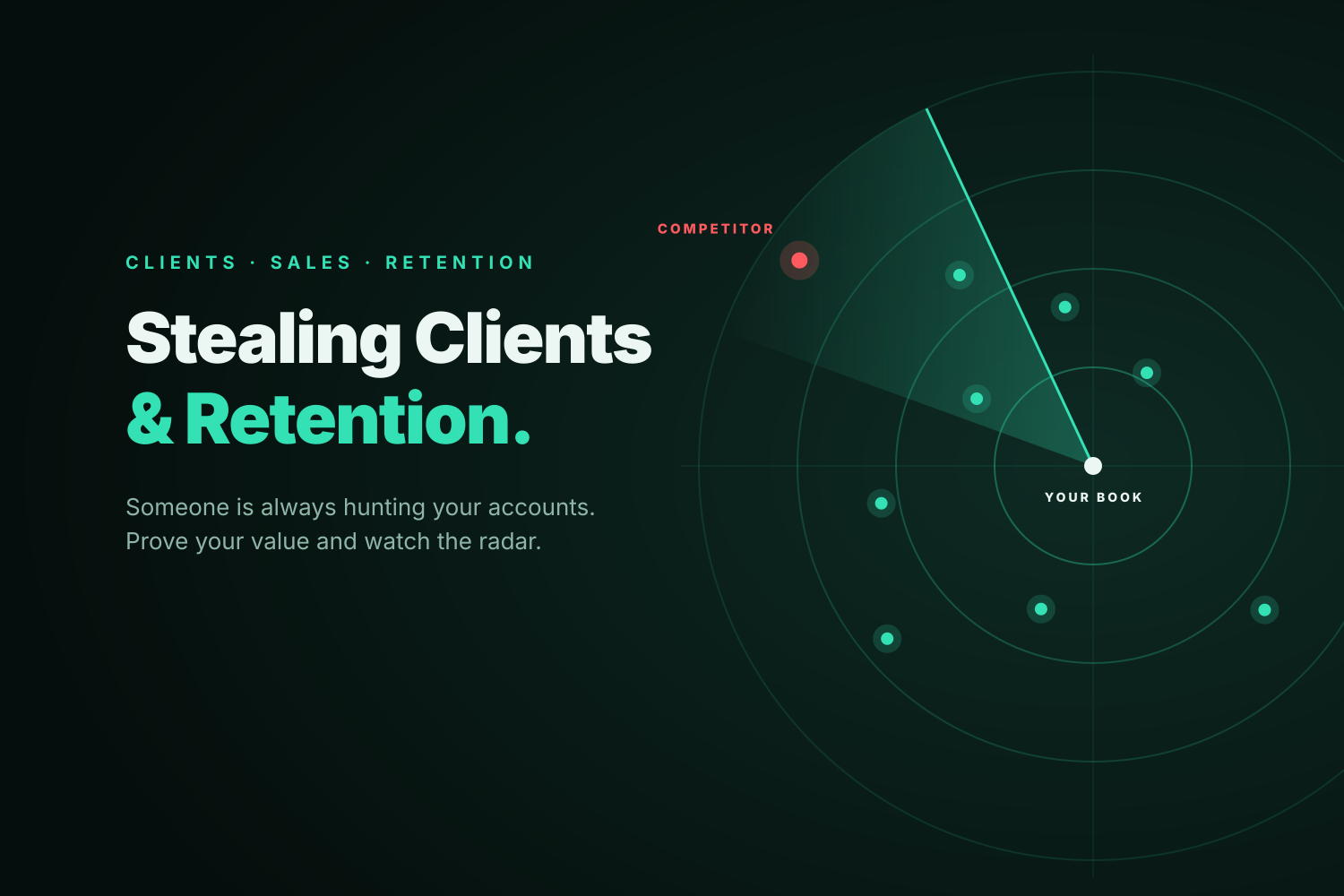
Other businesspeople are going to try to steal your clients. All the time. It never ends.
When that happens, you need to be ruthless in your thinking, your mindset, and your demeanor. In business, you need good salesmanship, or the other guy is going to steal your clients.
The Golden Idea
Your clients need to fully believe, acknowledge, and tell you one important thing:
Their business’s success is coming directly from your work.
Until that idea sinks in, you haven’t won them over as part of your road-base book of business, the rock-solid clients everything else is built on.
Once you do win a client over, they’ll stick with you for at least another 6 months. That buys you time to keep performing, grow the relationship, and show them more of your personality.
Inoculate Your Clients Against Poachers
Here’s a trick: warn your clients before the competition shows up.
Something like: “Heads up, now that your ads are performing, you’re going to get calls from other agencies promising cheaper prices or guaranteed results. That’s normal. If you ever want a second opinion on one of those pitches, send it my way.”
Now when the poacher calls, it doesn’t feel like a discovery. It feels like you predicted it. You look like the expert, and they look like exactly what you said they’d be.
Watch out for the usual poacher pitches:
- “We’ll do it cheaper.” Cheaper usually means less attention and fewer results.
- “We guarantee page 1” or “guaranteed leads.” Nobody can honestly guarantee that.
- “Your current agency is wasting your money.” Said without ever seeing the account data.
Automated Reports: Your Early Warning Radar
Another favorite retention tactic of mine: automated email report campaigns.
I love them because they work like a radar. They tell you how the account is performing before the client tells you. If the report shows the account needs optimization work, so be it. It’s much better to get that signal proactively, from an automated report, than reactively, from an angry call or email.
A good automated report keeps it simple:
- The numbers the client cares about: leads, sales, revenue, cost per result
- A comparison to last month and last year
- One or two lines of plain-English commentary on what it means
Every report is a reminder that your work is driving their results. That’s the golden idea, delivered to their inbox every month.
Managing Your Time Across the Book
When you’re a highly skilled professional, lots of people want your time. Here’s the checklist I use to decide where it goes:
- Contract duration: Accounts coming up for renewal get extra attention well before the end date.
- Performance and happiness: Unhappy or underperforming accounts get fixed first. Happy ones get growth conversations.
- Seasonality: A pool company in March or a retailer in November needs you more than they do in the off-season.
- Account size: Bigger accounts get more of your time. That’s just math.
Free or Very Expensive
Try thinking about your services as either free or very expensive:
- Free: rapport-building through consulting and sales calls. Give value generously to build trust.
- Very expensive: the actual work, because it works, and few people can match the value you bring to the marketplace.
Nothing in the cheap middle. That combination of skill and salesmanship is what improves client retention.
Results Are the Report Card
The marketplace cares about value and results. Analytics are the marketplace’s report card for how well your services solve real problems.
My craft solves the “no business” problem. Marketers drive more business, which means more revenue.
Good businesspeople understand that expensive services can be effective, necessary, and worth it. They aren’t afraid to pay. They need the problem solved, and without your service, their business suffers.
Once clients start thinking of you that way, retention goes up, and the poachers stop getting callbacks.
Leave a Reply