Lead generation accounts are my favorite so far in my career, because there’s a formula for success with them. When the formula is in place, results become predictable. When a piece is missing, you can usually spot exactly which one.
The Lead Generation Formula
- A well-designed, informative landing page or website. Fast, mobile-friendly, clear offer, and one obvious next step: call, book, or fill out the form.
- Multiple ad groups and keywords converting through search (SEM). You want more than one winner, so the account isn’t living or dying on a single keyword.
- A business owner who closes the leads. I like to see a closing rate of roughly 30% to 40%, though it varies a lot by industry and price point. Marketing can fill the pipeline, but someone still has to pick up the phone.
From there, it’s all about optimizing the campaigns: better click-through rates, better conversion rates, and a lower cost per acquisition.
Here’s the part a lot of marketers miss: step 3 is often the biggest lever, and it’s the one you control the least. If a client is closing 15% of leads and you help them get to 30%, you just doubled their return without spending another dollar on ads. That’s why I always ask about the sales process, not just the ad account.
Common Client Questions (and How I Answer Them)
After managing a lot of lead gen accounts, I hear the same questions over and over. Here are the big three, plus a few bonus ones.
1. Why is marketing important?
Good marketing gets you more customers and clients, which grows your business and makes you more money. Marketing is an investment, not an expense.
Without digital marketing, it’s very hard to grow a business today. Unless you have a brand like Nike or GaryVee, where people already come looking for you, you need marketing to get in front of the people searching for what you sell.
Think of it this way: someone is on Google right now typing in exactly what you offer. The only question is whether they find you or your competitor.
2. What’s my ROI?
This is the most important question a client can ask, and you should be able to answer it without flinching.
For ecommerce, it’s fairly straightforward. Pull total sales from the back end (Shopify, BigCommerce, WooCommerce) and compare them to the ad spend. Revenue divided by ad spend gives you your return on ad spend (ROAS). To get true ROI, you also need to factor in product costs and margins, because $10,000 in sales on a 20% margin product is a very different story than on a 70% margin product.
For lead generation, you need three numbers from the business owner:
- How many leads the marketing is driving per month
- Their closing rate on those leads
- The average revenue from a new customer
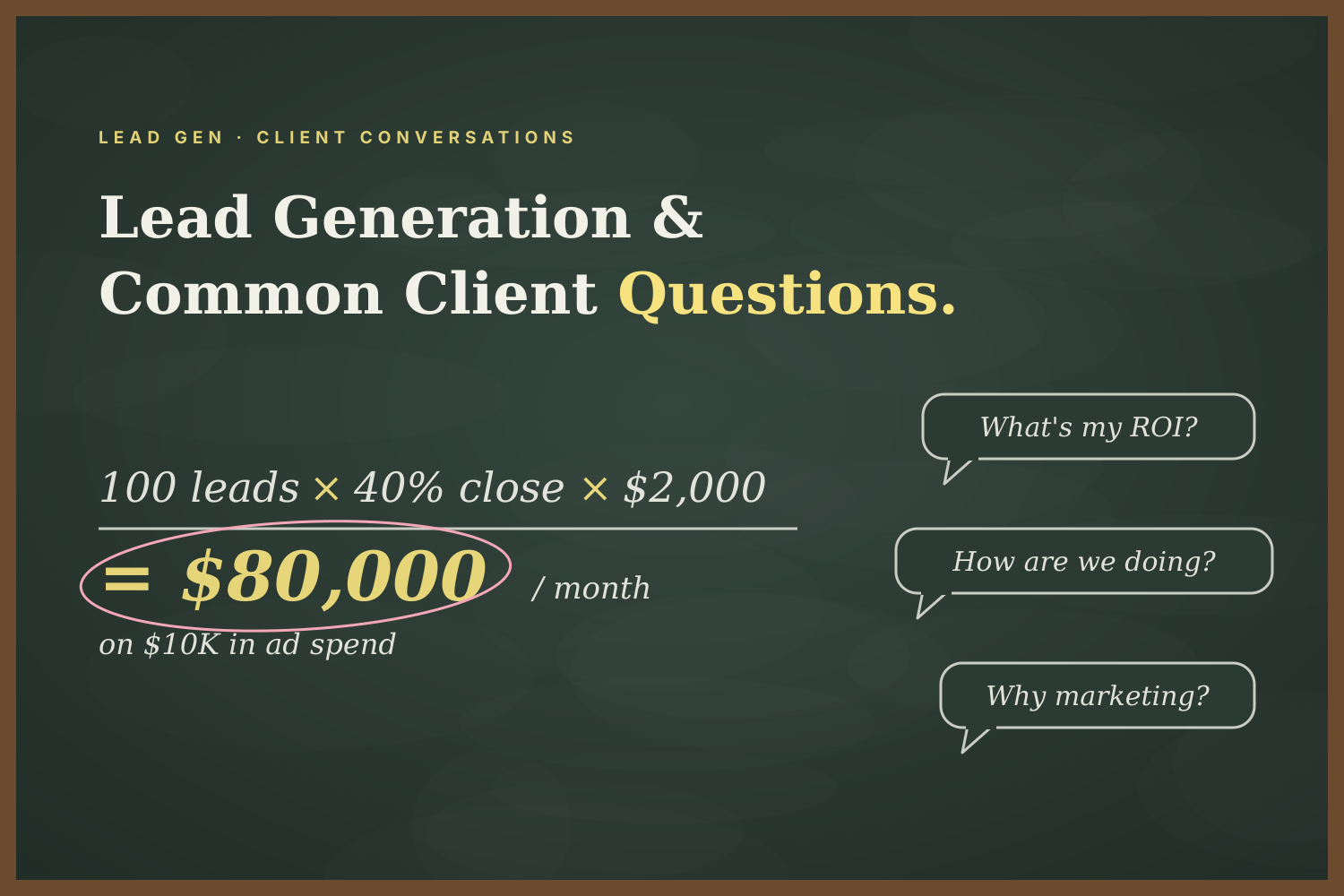
Here’s an example. Say you drive 100 leads, spend $10,000 to get them, and the client closes 40% of them. Each job is worth $2,000.
- Cost per lead: $100
- New customers: 40
- Cost per new customer: $250
- Revenue generated: $80,000
That’s $8 in revenue for every $1 spent on marketing. That’s a good month.
If the client doesn’t know their closing rate or average job value, help them start tracking it. Even a simple spreadsheet or a basic CRM changes the conversation from “I feel like the ads are working” to “I know the ads are working.”
3. How are we doing?
Early in my career, my default answer was “We’re doing fabulous.” Confidence matters, and clients want to feel like they’re in good hands.
But as a professional, it’s your duty to never sugarcoat the results. If performance isn’t where it should be, call it out before the client does. Something like:
“Look, I know the last week or so has been a little slow, and I get that. Here’s what I’m doing with the marketing based on the Analytics data, our conversations, and what I’m seeing in your industry.”
Clients love knowing you’re building tailored, custom solutions for their business’s specific needs and problems. Owning the bad weeks is what makes them trust you on the good ones. It’s one of the most effective ways to build rapport.
Bonus: Why did my leads drop?
Before you panic, check the usual suspects:
- Seasonality. Many industries slow down around holidays or certain months.
- Budget. Did the campaign hit its daily budget early or get limited?
- Tracking. Is the form or call tracking still firing? Broken tracking looks exactly like a drop in leads.
- Competition. A new competitor bidding on your keywords can push up costs fast.
- The website. Was anything changed on the landing page recently?
Bonus: Why are the leads bad?
Lead quality complaints are normal, and they’re useful. Ask the client which leads were bad and why. From there, you can add negative keywords, tighten location targeting, adjust ad copy to pre-qualify people, or add a question to the form. Better feedback from the client means better leads from the campaigns.
What Makes a Great Lead Gen Partnership
The best lead generation accounts I’ve worked on all had a few things in common:
- Regular communication. A quick weekly or biweekly check-in beats a long report nobody reads.
- Shared numbers. The client shares closing rates and job values, and the marketer shares spend and lead data. Both sides see the full picture.
- Patience to test. Not every ad, keyword, or landing page will win. Testing is how you find the ones that do.
- Fast follow-up on leads. The faster a business responds to a new lead, the better its chances of closing it. Minutes matter.
- Clear goals from day one. Agree on a target cost per lead and a monthly lead volume up front, so everyone knows what “good” looks like before the first dollar is spent.
The Bottom Line
Lead generation works when the marketing, the website, and the sales process all pull in the same direction. Nail the formula, know your numbers, and be honest with your clients about the results. Do that consistently, and you won’t just keep clients. You’ll grow them.
Leave a Reply