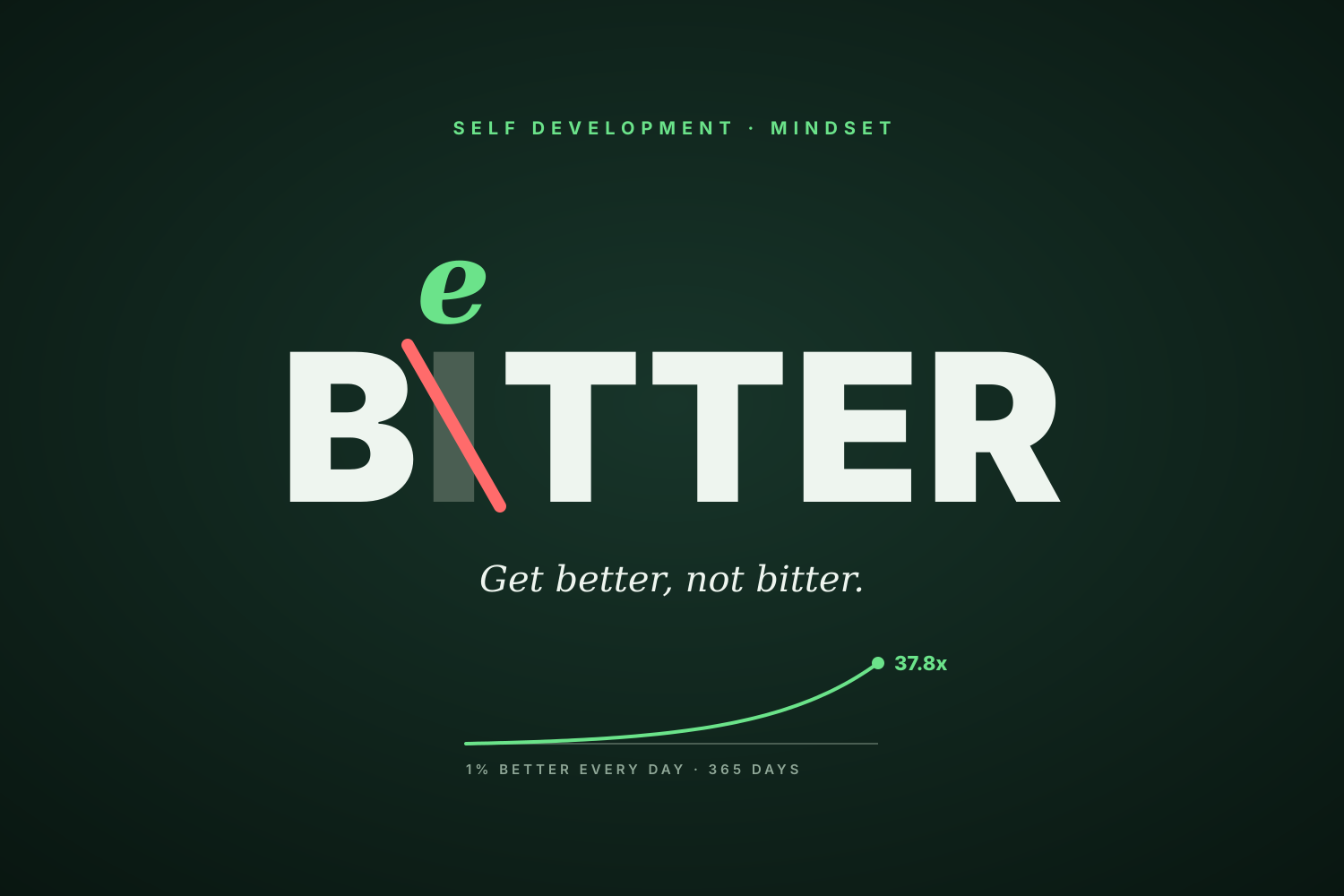
Don’t be bitter. Be better.
Life Isn’t Fair
Look, life is unfair. Sometimes really unfair.
In my experience, it’s very easy to become bitter when, say, a colleague gets ahead in their career without earning it through performance. That’s extremely frustrating for high performers who pride themselves on hitting goals, getting better, and earning more.
But sometimes life doesn’t play out the way you thought it would, or the way you believe it should have.
Maybe someone else got the promotion. Maybe a client you worked your tail off for left anyway. Maybe the company changed your commission plan right after you finally figured out the old one. Maybe someone with half your work ethic got lucky and passed you by.
In those moments, as hard as it is (and it is hard), you can’t let yourself become bitter. You have to become better.
Bitterness Is a Terrible Investment
Bitterness is a complete waste of time and energy. Think about it like an investor:
- The cost: Hours of replaying the situation in your head, worse sleep, worse moods, and worse work.
- The return: Zero. The colleague still got the promotion. The client is still gone.
All cost, no return. If a rental property performed like that, you’d sell it tomorrow. So why keep holding onto bitterness?
Worse, bitterness compounds the wrong way. It makes you cynical, cynicism makes you lazy, and laziness makes you fall further behind, which gives you more to be bitter about. It’s a downward spiral, and it can quietly eat years of your life.
Focus on What You Control
The Stoics had the answer to this two thousand years ago. Epictetus taught that some things are within our control and some things aren’t. Suffering comes from obsessing over the things we can’t control.
- Not in your control: Who your boss promotes, office politics, the economy, other people’s luck.
- In your control: Your effort, your skills, your attitude, your systems, and how you respond.
Bitterness lives entirely in the first column. Getting better lives entirely in the second. Spend your energy where it actually earns a return.
How I Turn Bitter Into Better
Here’s what’s worked for me:
- Feel it, briefly. Pretending you’re not frustrated doesn’t work. Give yourself a day to be annoyed. Then you’re done.
- Take a dose of humility. Ask honestly: is there something I could have done better? Usually there is. It worked for me.
- Fix your systems. Maybe a change in how you run your process is what improves your top-line performance. It worked for me.
- Ask for feedback. Go to the person who made the decision and ask what it would take next time. Most people never ask, so the ones who do stand out.
- Write down three things that went right. Bitterness narrows your vision to what went wrong. Gratitude widens it back out.
- Get back to work. Nothing kills bitterness faster than momentum.
When your mind is focused on getting better instead of bitter, a wonderful sense of lightness comes over you. The weight lifts. Your energy comes back.
You Can’t Be the Best Every Month
Landing in the middle of the pack instead of out front changes how a high performer sees themselves. It’s humbling.
Maybe, just maybe, we can’t be the best every single month. We’re human. Sure, Type-A people will scoff at that, and rightfully so. That drive is what makes them great.
But is your quality of life actually better if you expect to be the best all the time?
It’s not possible to always be the best. There will always be someone better, fitter, richer, smarter, more creative, more connected, better spoken, taller, tanner. The list goes on and on and on.
Run Your Own Race
So what’s the lesson?
Be your best self. Strive to be better than you were yesterday. You don’t need to be better than Frank or Jill down the hall. That’s not your race. Your race is self-development and personal growth.
Comparison is the fuel bitterness runs on. The moment you stop measuring yourself against Frank and start measuring yourself against last month’s version of you, the bitterness has nothing left to burn.
Two People, Same Setback
Picture two top performers at the same company. Both get passed over for the same promotion. Same disappointment, same unfair outcome.
The bitter one complains at lunch every day. He starts doing the bare minimum, because “what’s the point?” He stops learning, stops reaching out to clients, and starts updating his résumé out of spite instead of strategy. Five years later, he’s still telling the same story about how he got screwed.
The better one is just as frustrated for a day or two. Then he asks for feedback, sharpens his skills, tightens up his systems, and builds relationships outside his department. Maybe he gets the next promotion. Maybe he leaves for a better company that sees his value. Maybe he starts his own business. Five years later, he barely remembers the promotion he didn’t get.
The setback was identical. The response made all the difference.
The Math of 1% Better
Get 1% better every day, and in a year you won’t recognize yourself.
That’s not just motivational fluff. It’s math. James Clear made this famous in Atomic Habits:
- 1% better every day for a year: 1.01365 ≈ 37x better
- 1% worse every day for a year: 0.99365 ≈ almost zero
Bitterness is the 1% worse. Getting better is the 1% better. Same starting point, completely different destinations. It’s compound interest, applied to you.
What 1% Better Looks Like
It doesn’t have to be dramatic. Small reps, every day:
- Career: Make one more sales call. Learn one new feature in the ad platform. Write a cleaner client report.
- Money: Cancel one subscription you don’t use. Move an extra $50 into your investment account.
- Fitness: One more rep. Five more minutes of walking. One better meal.
- Mind: Ten pages of a good book. Ten minutes of meditation. One less hour of scrolling.
None of these feel like much on day one. Stack them for a few years and they change your life.
The Bottom Line
Life will be unfair. People will get things they didn’t earn. You’ll land in the middle of the pack sometimes. None of that is in your control.
What you do next is.
Get better, not bitter. 1% better every day.
Leave a Reply