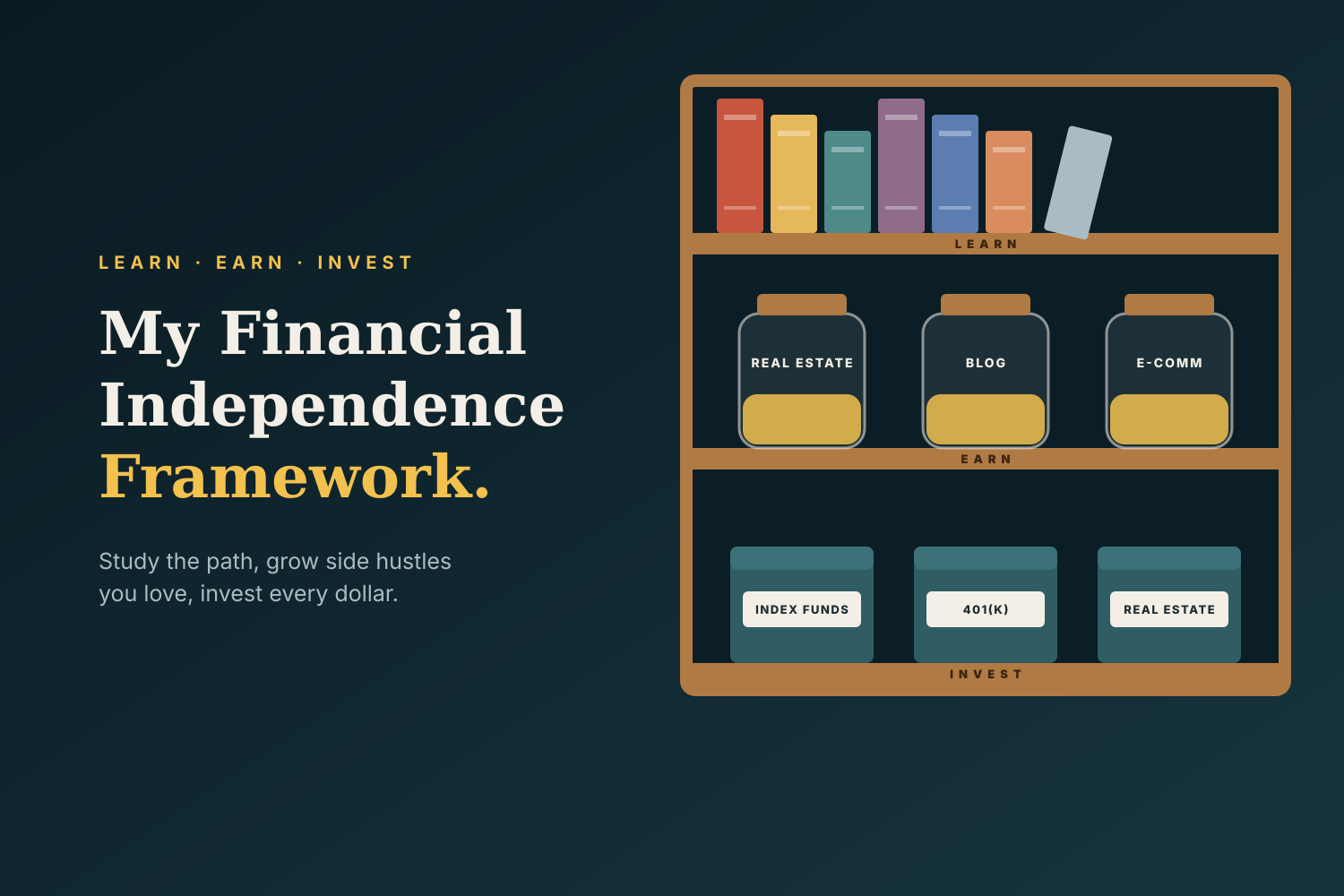
Financial independence doesn’t happen by accident. It happens because you have a framework: what you learn, how you earn, and where you put the money. Here’s mine, broken into three parts.
Learn it. Earn it. Own it.My FI framework in six words
Part I: Learn It (My FI Reading List)
Nobody taught me about money growing up. Everything I know, I taught myself. These are the books, blogs, and podcasts that built my foundation, and I still recommend every one of them:
- Rich Dad Poor Dad by Robert Kiyosaki: the book that first showed me the difference between assets and liabilities.
- The E-Myth Revisited by Michael Gerber: why most small businesses fail, and how to work on your business instead of just in it.
- Mr. Money Mustache: the blog that made frugality and early retirement feel fun.
- Early Retirement Extreme by Jacob Lund Fisker: the hardcore version. You don’t have to go this far, but it stretches your thinking.
- BiggerPockets: the best free real estate education on the planet.
- ChooseFI: a podcast and community full of real people sharing real numbers.
- Mad Fientist: smart, tax-focused strategies for reaching FI faster.
- The Simple Path to Wealth by JL Collins: the clearest case for low-cost index funds ever written.
- The Pathless Path by Paul Millerd: a newer favorite about stepping off the default career path.
If you’re just starting, read The Simple Path to Wealth first. It’s short, simple, and it will save you from a lot of expensive mistakes.
Part II: Earn It (My Career Engine)
Your income is the engine of your FI plan. You can only invest what you earn and keep.
For years, I ran a W-2 marketing career alongside a few side hustles: real estate, this blog, and online business. The goal was always to let those side projects grow until I didn’t need the paycheck.
Today, I work for myself full time. I’m a part owner and operator of Athena Digital, a performance marketing agency, and I run my own media buying and affiliate work alongside it. My income streams now look like this:
- Agency work: helping businesses grow with paid ads and lead generation.
- Affiliate and media buying: running my own campaigns and earning on performance.
- Rental real estate: a small portfolio in Northern Colorado, built through house hacking.
- Publishing: this blog, which I’m rebuilding into something bigger.
Any one of these can grow into a serious business. They have the best odds of working because I’m passionate about all of them and the market clearly wants what they offer.
I also get bonus lifestyle quotient (LQ) points, because I genuinely enjoy the work. It sits right at the intersection of my values, my passions, and my natural strengths. When your work feels like that, the long game gets a lot easier to play.
The Geo-Arbitrage Bonus
Most of my work can be done from anywhere with a laptop and Wi-Fi. That opens the door to geo-arbitrage: earning in dollars while spending time in places with a lower cost of living. Every dollar saved on living costs is another dollar that can go into assets and build more passive income.
Part III: Own It (My FI Vehicles)
Earning money is only half the game. The other half is turning that money into assets that work for you. Here are the vehicles I use and why.
| Vehicle | What it does | Effort level |
|---|---|---|
| Low-cost index funds | Broad, diversified growth | Very low |
| Tax-advantaged accounts | Lower your tax bill | Low |
| Rental real estate | Cash flow, leverage, tax benefits | Medium to high |
| Business ownership | Income and equity you control | High |
| Short-term Treasuries | Safe yield for dry powder | Very low |
1. Broad, Low-Cost Index Funds
This is the backbone. Index funds are highly liquid, completely passive, and cheap. I own a simple mix of U.S. and international total market funds, so I own a slice of thousands of companies around the world. JL Collins makes the full case in The Simple Path to Wealth, and I haven’t found a better one. I automate contributions and rarely look at the balance.
2. Tax-Advantaged Accounts
Most people know about the 401(k), and for a lot of people it’s the only investment account they ever use. But there’s so much more out there:
- Roth IRA: pay taxes now, grow and withdraw tax-free in retirement.
- HSA: if you qualify, it’s triple tax-advantaged for health costs.
- Solo 401(k) or SEP IRA: for the self-employed, these let you save far more than a regular IRA.
Becoming self-employed changed my account setup completely. If you work for yourself, these accounts are worth learning inside and out.
3. Real Estate
Real estate is a hybrid vehicle. It can be passive (REITs, syndications) or active (owning and running your own rentals, which is really a small business). I chose the active route through house hacking: living in one unit while renting the others. It let me buy with a small down payment and lock in low fixed-rate mortgages that are still paying off today.
4. Business Equity
Owning part of a business is the most hands-on vehicle, but it can also be the most powerful. You control the growth, and a well-run business builds value you could eventually sell, or keep paying yourself from for decades.
5. Dry Powder
I keep a cash cushion in short-term Treasury bills. It earns a solid yield while it waits, and it’s ready for emergencies or the next good opportunity.
How It All Fits Together
The framework is a loop: learn how money works, earn as much as you can doing work you enjoy, own assets that produce income, then repeat until your passive income covers your lifestyle. A common target is about 25 times your annual expenses.
No single vehicle gets you there alone. Together, they build a foundation that can handle bad markets, slow months, and whatever life throws at you. That’s the whole point. Financial independence isn’t about a number. It’s about freedom: the freedom to choose your work, choose who you work with, and spend your time on what matters most to you. Build the framework, stay consistent, and give it time. The results compound just like the money does.
Leave a Reply