These are my study notes on the modern economy, written as I worked through books, videos, and articles on money, debt, and the dollar. Some of these ideas shaped how I invest. Others I’ve since updated. I’ll cover both.
The Notes (January 2019)
1. The Debt Problem
The U.S. government is trillions of dollars in debt, roughly $22 trillion as I write this. Social Security, Medicare, and other entitlement programs are facing trillions more in future obligations.
Who is going to pay for all of this? The default answer has been to borrow more and create more money. That can’t go on forever without consequences.
One consequence people overlook is interest. The bigger the debt gets, the more of the federal budget goes to paying interest on it instead of roads, schools, or defense. Higher interest costs can also push up borrowing rates for everyone else, including the mortgages and car loans regular families depend on. Debt doesn’t just sit on a balance sheet. It shows up in your monthly payments.
2. The Shrinking Dollar
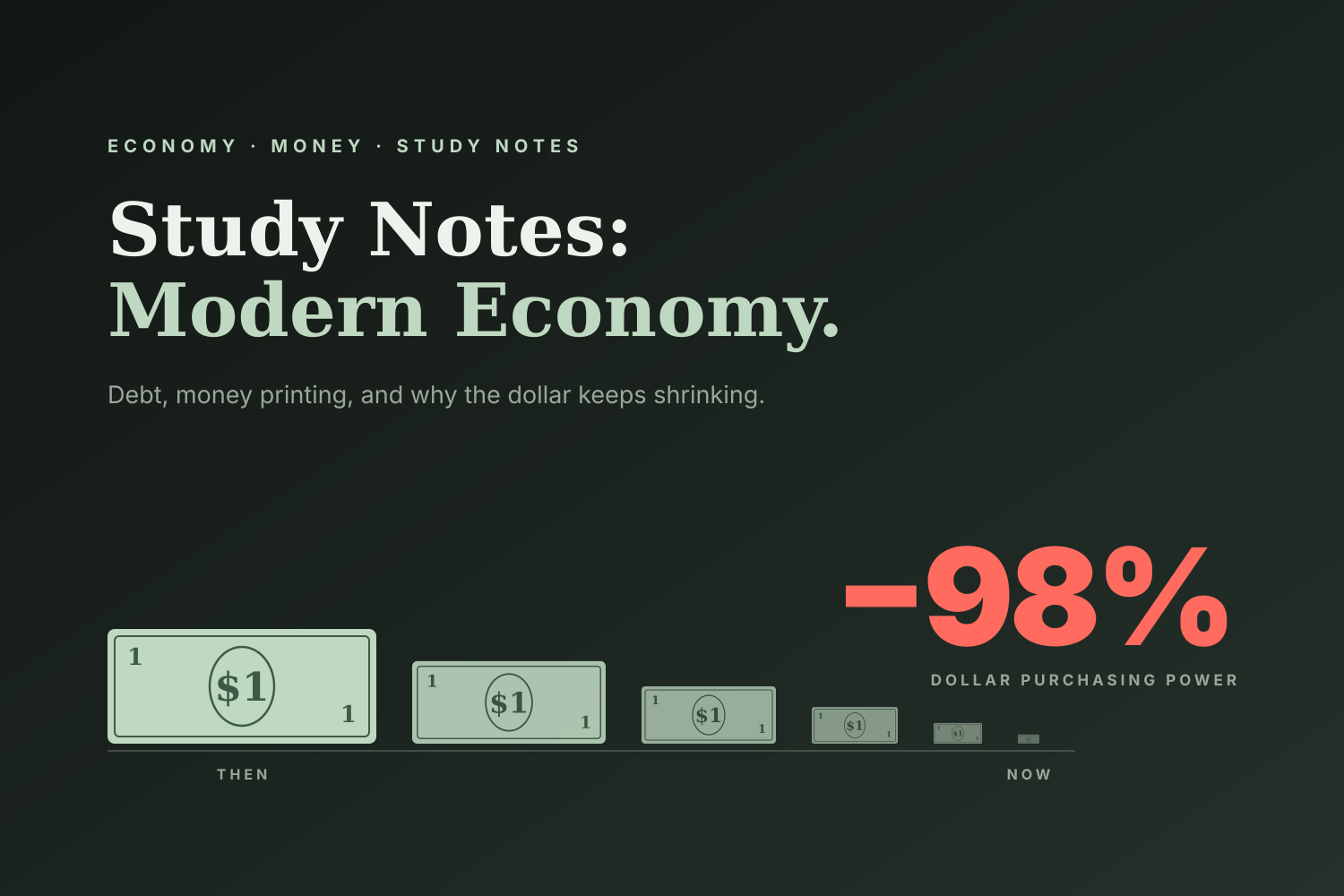
The dollar has lost about 96% of its purchasing power since the Federal Reserve was created in 1913. Something that cost $1 back then costs more than $25 today.
The more money the system creates, the less each dollar is worth. That makes it harder and harder for the lower and middle class to afford a good standard of living: education, housing, food, entertainment, everything that makes up your lifestyle quotient (#LQ).
3. 1971: The Turning Point
Under the Bretton Woods system set up after World War II, the U.S. dollar was tied to gold. In 1971, President Nixon ended that link. From then on, the dollar has been backed by trust in the U.S. government rather than by gold.
Since then, money and debt have grown together. Most new money enters the economy through lending. And yet, the way we teach people about money in school hasn’t really changed to reflect that new reality.
4. The Squeezed Middle Class
- Food stamp usage has climbed over the past couple of decades.
- Many jobs have moved overseas.
- The middle class is shrinking.
- Millions are going back to school in search of that “high-paying job.”
With tuition at astronomical levels, that strategy doesn’t always pay off. Many people graduate with a lot of debt, no real education about money, and an income that doesn’t make up for the years and dollars they spent.
5. Boomers or Busters?
As baby boomers retire, they’ll lean heavily on Social Security, Medicare, and their savings. If the system can’t support everyone, a lot of boomers could become busters.
6. The Worst-Case Scenario
History is full of countries that printed money until their currency collapsed. Weimar Germany, Zimbabwe, and Venezuela are the famous examples. In a true currency collapse, a millionaire can become a pauper in just a few years.
My Takeaways in 2019
Back then, my conclusion was blunt: the stock market isn’t where to put your money. Real estate and businesses are.
My advice was to put earned income into real assets (real estate, gold, silver, and some cash on hand) while still dollar-cost averaging into a 401(k), Roth IRA, crypto, and peer-to-peer lending every payday. The logic: you can’t beat the market or influence it, so you might as well buy steadily and let time do the work.
Looking back, you can see I was a bit torn. I said stocks weren’t the place, then told you to invest in them every payday. That tension is the real story of this post.
Revisiting These Notes in 2026
Seven years later, here’s what held up and what didn’t.
What Held Up
- The debt kept growing. It roughly doubled. The national debt passed $40 trillion in August 2026.
- Inflation is real. The post-COVID inflation spike in 2021 and 2022 reminded everyone how quickly the dollar can lose purchasing power.
- Real assets matter. Real estate and gold both did well over this period.
- Schools still don’t teach money. Personal finance education is improving in some states, but most people are still on their own.
What Didn’t Hold Up
- The dollar didn’t collapse. It lost value to inflation, but it’s still the world’s reserve currency. Debt is a serious long-term problem, but “collapse in 4 years” was too dramatic.
- The stock market was a great place for money. U.S. stocks have more than doubled since I wrote these notes. Avoiding them would have been a costly mistake.
- The long-term return figure was off. Historically, the S&P 500 has averaged around 10% a year before inflation, or about 7% after inflation. Not 7.5%, and not every year.
How I Think About It Today
Here’s the irony: inflation is exactly why owning stocks makes sense. Companies raise prices when costs go up, and over time their earnings and share prices tend to rise with them. Stocks are ownership in real businesses, which is the same thing I said I wanted in 2019.
Today, I don’t think of it as real estate or stocks. I own both. Rentals give me cash flow, leverage, and tax benefits. Broad index funds, both U.S. and international, give me simple, diversified, hands-off growth. Each covers the other’s weak spots.
I also dropped the doomsday prepping mindset. Fear made for compelling content, but it’s a terrible investment strategy. A steady plan you stick with beats a dramatic prediction almost every time.
My Updated Advice
- Own assets, not just dollars. Cash loses value over time, so keep an emergency fund and invest the rest.
- Dollar-cost average into broad index funds. Automate it every payday and ignore the headlines.
- Add real estate if it fits your life. House hacking is still one of the best ways to start.
- Build skills and income. Your earning power is the best hedge against inflation.
- Keep learning, but question your sources. Look for evidence, not just a scary story.
These notes were an important step in my financial education. They got me asking the right questions. It just took a few more years, and a few real market cycles, to land on better answers.
Leave a Reply