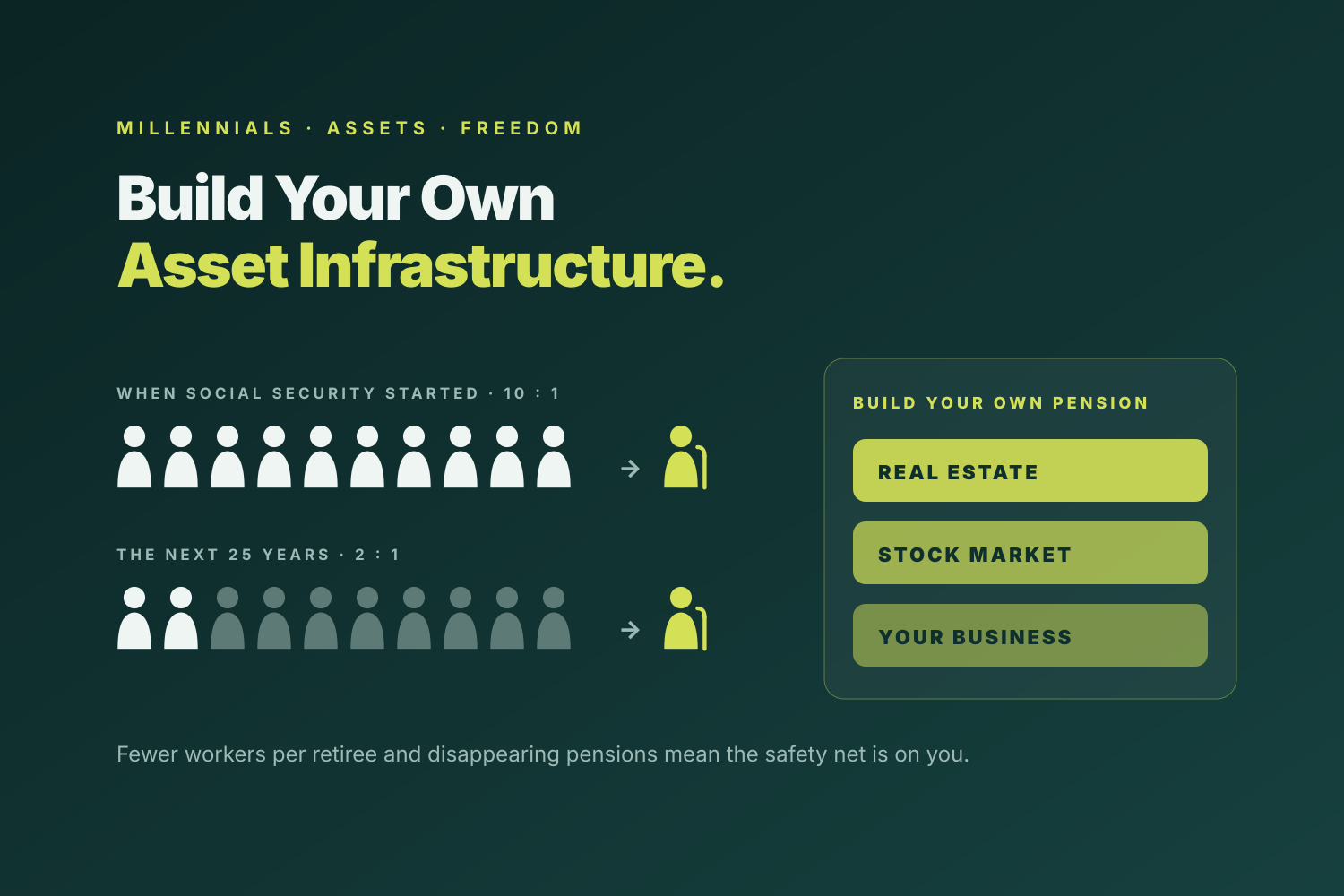
Young people need to use their time and money in ways that effectively set up their own pension funds. That means buying and building assets in real estate, the stock market, and business.
I call this building your asset infrastructure: a collection of income-producing assets that pays you whether or not you show up to work. The earlier you start building it, the more time it has to grow.
Why We Can’t Count on the Old System
Our parents and grandparents had two big safety nets for retirement: Social Security and a company pension. For millennials, both are looking a lot shakier.
1. Social Security Is Under Pressure
Social Security is funded by today’s workers paying for today’s retirees. That works great when there are lots of workers per retiree. It gets harder as that ratio shrinks.
- In 1960, there were about 5 workers paying in for every person collecting benefits.
- By 2025, that number had dropped to about 2.6.
- By 2034, it’s projected to fall to about 2.3, and eventually to about 1.9.
Fewer workers paying in means more strain on the system. According to the 2026 Social Security Trustees Report, the retirement trust fund is projected to run out of reserves in late 2032. After that, incoming taxes would only cover roughly 78% of scheduled retirement benefits unless Congress makes changes.
To be clear, Social Security isn’t going to vanish. But planning your future around a check that could be smaller than promised, at an age that could keep moving, isn’t a plan. It’s a hope.
2. Pensions Are Disappearing
Most private companies have replaced pensions with 401(k) plans, which shift the responsibility of saving and investing onto you.
Part of the reason is the disruptive nature of the new economy. Companies rise and fall faster than ever. Expecting a company to be around for 40 years to pay your pension is like assuming you’ll stay young forever. It’s just not reality.
The takeaway: you are your own pension fund now. The sooner you accept that, the sooner you can start building one.
The Three Pillars of Asset Infrastructure
I believe young people should focus on three main asset channels:
- Real estate
- The stock market
- Your own business
You don’t need all three on day one. But over time, each one plays a different role, and together they make your financial foundation much stronger.
Pillar 1: Real Estate
I like real estate because housing is a basic human need, and it will be for as long as humans are around.
Rental property can pay you in several ways at once: monthly cash flow, tenants paying down your mortgage, tax benefits, and appreciation over time. For a young person, house hacking (living in one unit and renting out the others) is one of the best ways to get started with a small down payment.
In my own journey, the next phase is all about gaining skills, experience, and relationships in the real estate industry. That includes:
- Reading and understanding financial statements
- Following economic reports and the local market
- Operating and maintaining a property
- Finding, screening, and working with tenants
Each of those deserves its own post, and I’ll get to them. The punchline is that there are lots of ways to make money investing in real estate, and the learning curve is worth climbing.
Pillar 2: The Stock Market
The stock market is the most hands-off pillar. You can own a slice of thousands of companies through low-cost index funds, with no tenants and no toilets.
The key is to start early and stay consistent. Max out any employer 401(k) match first, since that’s free money. Then look at a Roth IRA and a regular brokerage account. Automate your contributions so investing happens before you have a chance to spend the money.
Time is the biggest advantage a young investor has. A dollar invested in your 20s has decades more to compound than a dollar invested in your 40s.
Pillar 3: Your Own Business
I understand not everyone wants to run a business. That’s fine. Just skip my business content.
But here’s what I believe: owning your own business is the single greatest vehicle available to get rich and achieve financial freedom, the ultimate lifestyle quotient. A business lets you control your income, scale beyond your own hours, and build an asset someone may one day want to buy.
It doesn’t have to start big. A side hustle, a freelance service, or a small online business can grow into something meaningful. The skills you build along the way (sales, marketing, managing money) also make you better at the other two pillars.
How the Pillars Work Together
Here’s how I see the three fitting together:
- The business generates the income and builds your skills.
- Real estate turns that income into cash flow and long-term equity.
- The stock market gives you a simple, diversified, liquid place to grow wealth.
If one pillar has a bad year, the others can keep you steady. That’s the beauty of building infrastructure instead of relying on a single paycheck.
Your First Steps
If this feels overwhelming, start small:
- Build an emergency fund so a surprise expense doesn’t derail you.
- Pay off high-interest debt, since it works against everything else.
- Start investing a set amount every month, even if it’s small.
- Read one book or listen to one podcast a week on real estate, investing, or business.
- Pick one pillar to focus on this year, and go deep on it before adding the next.
The Sooner, the Better
Who would argue that reaching financial freedom later in life is better?
I want financial freedom as soon as possible, without killing myself in the process through unnecessary pain or suffering. That means working hard and smart now, living below my means, and putting every extra dollar to work in assets that will take care of me later.
If you’re a millennial reading this, start building your asset infrastructure today. Nobody else is going to build it for you. Brick by brick, asset by asset, year after year, it adds up to freedom.
Leave a Reply