What a Good Capitalist Actually Does
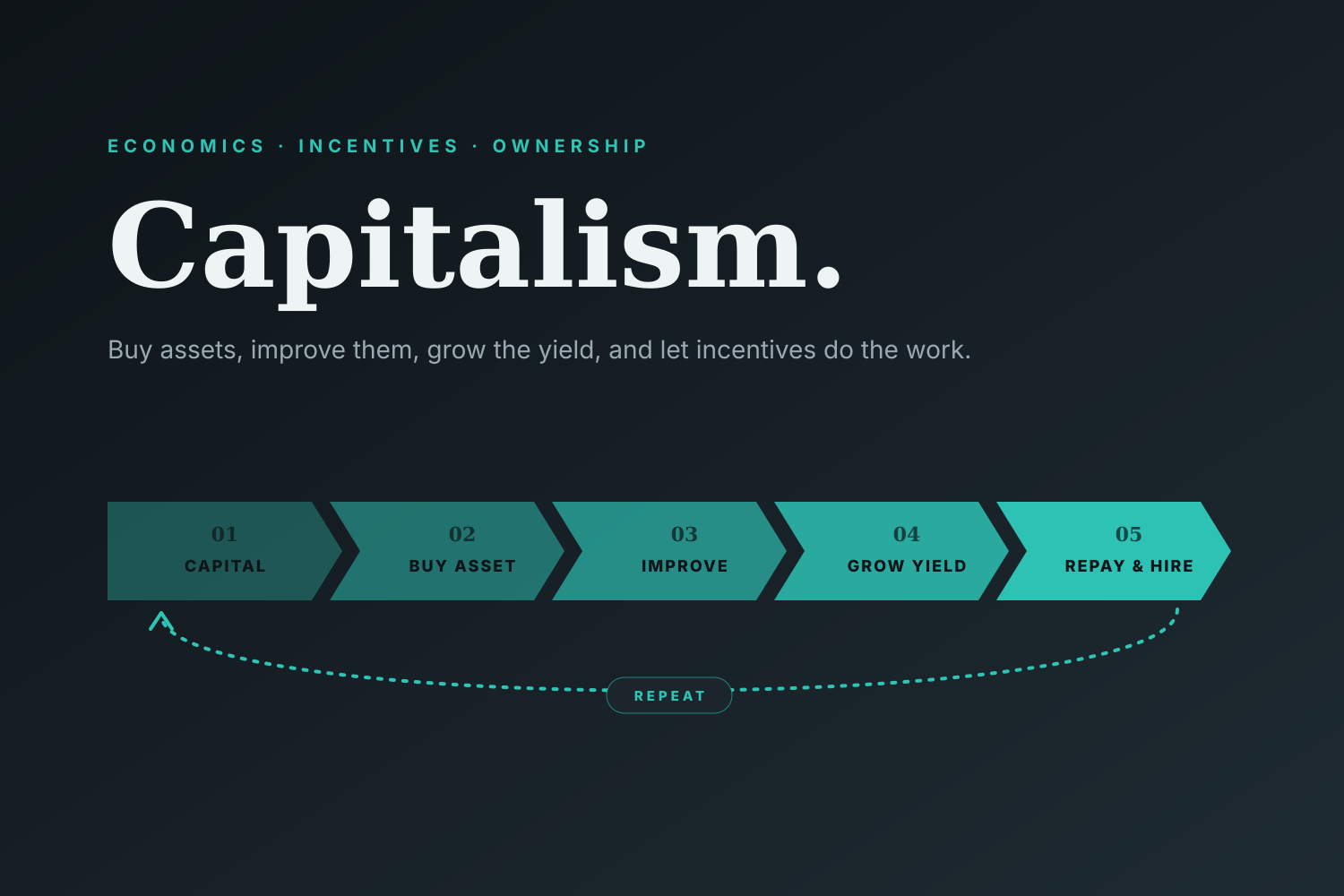
Here’s what a good capitalist does:
- Uses capital (their own or investors’) to buy appreciating, cash-flowing assets.
- Fixes up the asset, improving its value and its cash flow.
- Operates it better so its monthly yield keeps increasing.
- Uses that higher yield to pay back investors (if any) and hire employees to run the asset, while collecting a steady paycheck from it.
If that sounds familiar, it should. It’s basically the BRRRR strategy I write about on this blog: buy, rehab, rent, refinance, repeat. Every small landlord who fixes up a run-down duplex and rents it to a family is practicing capitalism in its purest form.
And notice who wins in that example. The investor gets a return. The tenant gets a clean, safe home that didn’t exist before. The contractor and handyman get paid work. The neighborhood gets a better-looking property. Capitalism done right isn’t one person winning at everyone else’s expense. It’s value created and shared.
Why I Believe in Capitalism
So far in human history, capitalism is the best economic system for sustained growth. It creates opportunities for everyone involved, it provides good jobs, and it improves the products, services, and infrastructure people get to enjoy. Socialism, in my view, doesn’t do this nearly as well.
The data backs it up. According to the World Bank, the share of the world living in extreme poverty fell from about 38% in 1990 to about 8.5% in 2019. That’s more than a billion people lifted out of extreme poverty in one generation. Much of that came from East and South Asia, especially China, as their economies opened up to markets and trade.
No central plan did that. Markets, trade, and people chasing better lives did.
A Story About Painting a Building
Here’s a story I once heard that illustrates the difference.
In the 1980s, a Russian official was explaining on TV why his country’s economy was struggling. Under the socialist system, he said, it might take a crew of 20 men two weeks to paint a building. They had zero incentive to work efficiently. They got paid whether they worked hard or not.
Give the same job to a painting contractor in New York City, and he’d finish it in two days. Why? Because he’s paid to get it done well and fast, so he can move on to the next profitable job.
I can’t vouch for every detail of that story, but the lesson rings true to me.
It All Comes Back to Incentives
A socialist system doesn’t carry the same incentives as a capitalist one. We all know that if you want to influence someone’s behavior, you have to line their incentives up with the goal.
If I know I’ll get paid exactly the same whether I do great work quickly or just show up and coast, most people will coast. It’s human nature to look for the easiest path.
I wrote a whole post about this called “What’s Your Incentive?” Incentives drive behavior, period. Capitalism works because it rewards people for creating value. When you remove the reward, you remove a lot of the effort.
I feel this every day as a small business owner. When I deliver results for a client, they stay, they spend more, and they refer their friends. When I don’t, they leave and hire someone better. Nobody has to stand over my shoulder telling me to work harder. The market does that for me, honestly and immediately.
Same with my rentals. If I keep a property clean, safe, and well managed, good tenants stay and pay on time. If I neglect it, the property, the tenants, and my cash flow all suffer. The incentive to do right by people is built right into the business.
“But What About Scandinavia?”
Whenever this topic comes up, someone points to Denmark or Sweden as proof that socialism works.
Here’s the thing: their own leaders disagree. In a 2015 speech at Harvard, Danish Prime Minister Lars Løkke Rasmussen said it plainly: “Denmark is far from a socialist planned economy. Denmark is a market economy.”
The Nordic countries run on markets, private property, and competition. They layer a generous welfare state on top, paid for with high taxes. You can debate whether that’s the right trade-off. But it’s a market economy with a big safety net, not socialism in the old sense of the government running everything.
To Be Fair: Capitalism Has Weak Spots
I believe in capitalism, but I’m not blind to its problems. Some critiques are worth taking seriously:
- Inequality: Returns to capital can outpace wages, so people who already own assets pull further ahead. I wrote about this in my post on economics and investing, where I worried about drifting toward an inherited-wealth economy.
- Boom and bust: Markets overshoot. 2008 hurt millions of people who did nothing wrong.
- Side effects: Pollution and other costs that don’t show up on a company’s income statement still land on someone.
- Lobbying and cronyism: When businesses use money to rig the rules, that’s not free-market capitalism anymore. That’s something worse.
Critics on the left would say these problems are built into the system and need stronger government control. Defenders would say most of them come from bad rules and cronyism, not from markets themselves. I land closer to the second view, with a belief in sensible guardrails: rule of law, real competition, and a basic safety net.
What This Means for You
Here’s the practical takeaway. Whatever you think about the system, you live in it. And in a capitalist economy, there are two ways to participate:
- As labor only: You trade your time for a paycheck. Your income stops when you stop.
- As labor and capital: You trade your time for a paycheck, then turn that paycheck into assets that earn money while you sleep.
The second group is where wealth gets built. You don’t need to be born rich to join it. A house hack, an index fund, or a small online business is your ticket in.
Capitalism isn’t perfect. It’s just the best system we’ve found so far for turning effort and ideas into value.
Stop just working in the system. Start owning a piece of it.
Leave a Reply