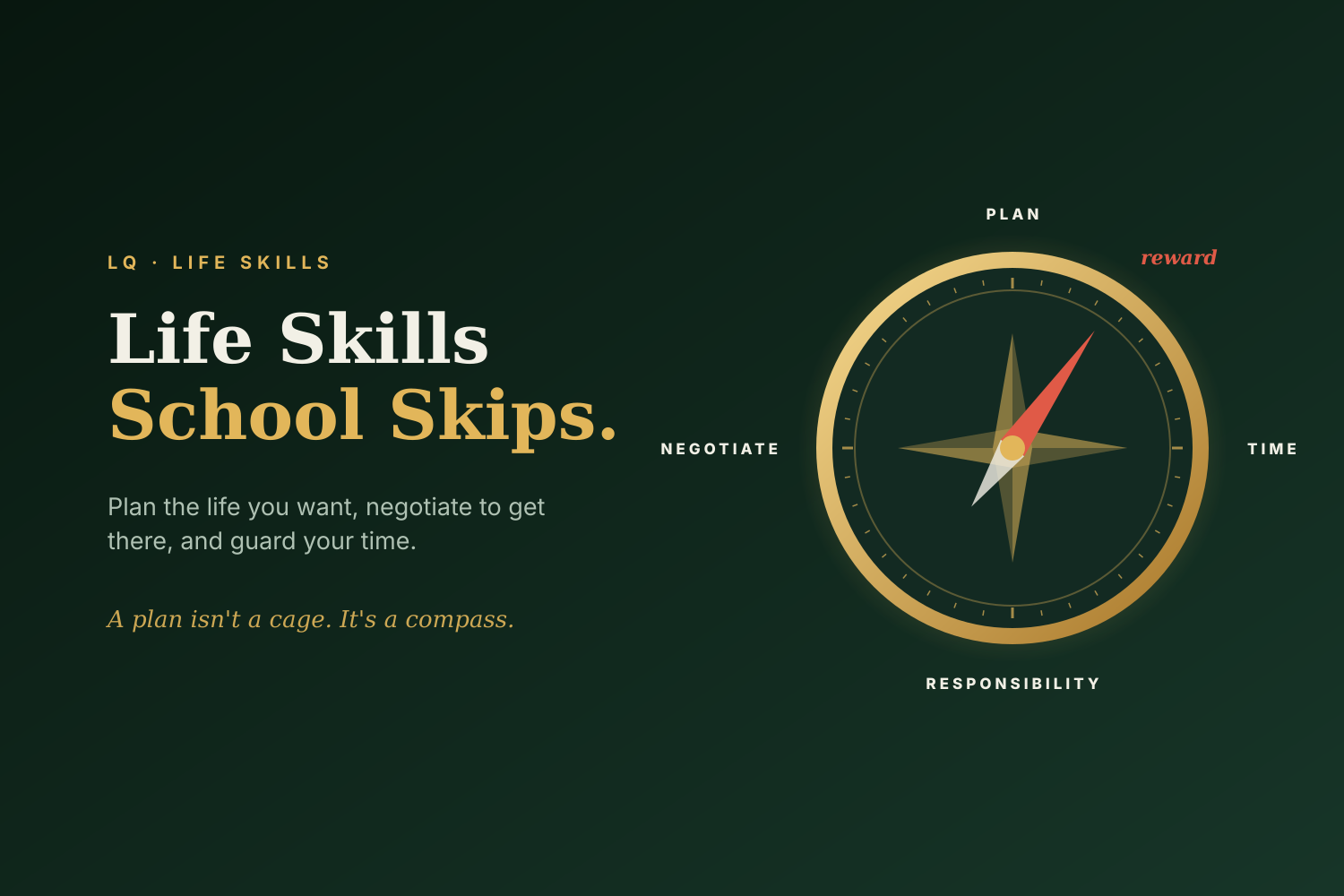
Here’s a good question to ponder often: what’s the best ratio between responsibility and reward?
Take on too little responsibility, and life gets small and boring. Take on too much, and you burn out. The sweet spot is where you carry enough weight to grow, and get enough reward to make it worth it. Finding that ratio is a life skill in itself.
A lot of the ideas in this post first clicked for me while reading and listening to psychologist Jordan Peterson around the time 12 Rules for Life came out. Years later, they still hold up. Here are the core life skills I keep coming back to.
On Negotiation
You must negotiate with yourself, not tyrannize yourself.
You aren’t your own slave. If you force yourself to grind every hour of every day with no reward, eventually you’ll rebel. You’ll procrastinate, quit, or burn out. Instead, make deals with yourself. “I’ll finish this proposal, then I’ll go play a round of golf.” “I’ll save this month, then I’ll book the trip.”
The same goes for the people you’ll spend years with: your life partner, your business partners, and, honestly, your own soul. Long relationships don’t work if one side always wins. They work when both sides keep negotiating and both sides keep winning.
In business, the goal is to move the deal needle in your favor while still making sure the other side wins too. That’s how you get repeat clients, referrals, and partners who want to work with you again.
- Know what you want before you walk in.
- Know what they want, and find ways to give it to them that cost you little.
- Know your walk-away point. The person who needs the deal least usually has the most power.
- Leave something on the table. A great deal for you and a bad deal for them isn’t a great deal. It’s a short one.
On Planning
Plan the life you want to have.
Here’s an exercise that works: have a conversation with yourself as if you didn’t know who you were. Pretend you’re a stranger who has been put in charge of your life. What would you want for this person? What would make them happy, healthy, and proud?
Then lay out a plan for the kind of life you would love living, or at least really enjoy living. Not a life shackled to the chains of working to pay off liabilities.
I like to plan across a few areas:
- Career and business: what work energizes you?
- Money: what does financial freedom look like, and when?
- Health: how do you want to feel at 40, 60, and 80?
- Relationships: who do you want in your life, and how close?
- Fun: travel, hobbies, adventures. The stuff that makes the rest worth it.
Write it down. Revisit it every year. A plan isn’t a cage. It’s a compass.
On Time Waste
One stat I heard from Peterson stuck with me: people waste around 6 hours a day on average, and the average person’s time is worth roughly $50 an hour. I can’t vouch for the exact numbers, but do the math anyway. That’s about $300 a day, or more than $100,000 a year, of potential value slipping away.
Even if the real number is half that, the point stands.
You should assume your time is valuable. Value it highly. When you do, you’ll make more money, have more fun, and be more productive, all at the same time.
And in 2026, the biggest time thieves are in our pockets. Endless scrolling, notifications, and short-form video are designed to grab hours without you noticing. A few things that help me:
- Check your phone’s screen-time report once a week. It’s a reality check.
- Turn off non-essential notifications.
- Block focused work time, and protect it like a client meeting.
- Use AI tools to handle busywork so you can spend your time on the high-value stuff.
- Ask, “Would I pay $50 an hour to do this?” If not, cut it, automate it, or delegate it.
Wasting time isn’t the same as resting, though. Downtime with people you love, a workout, or a walk outside are great uses of time. The waste is the stuff you don’t even remember doing.
On Responsibility
Back to that first question. One of the most counterintuitive things I’ve learned is that taking on more responsibility often makes life feel better, not worse.
Owning a rental, running a client account, building a business, being there for family. Each one adds weight. But each one also adds meaning. The people I know who seem the most lost are often the ones carrying the least. Pick up something heavy that matters to you. It’ll give your days direction.
On Macroeconomics
At the turn of this century, we were lifting people out of poverty faster than at any time in history. Over the long run, that’s true. In 1990, more than a third of the world lived in extreme poverty. Today, about one in ten people do. That’s hundreds of millions of lives changed.
But here’s the update: the progress has slowed way down. According to the World Bank, the share of people in extreme poverty has barely moved since the pandemic. Roughly 800 million people still live on less than $3 a day, and progress has stalled, especially in parts of Africa.
So the big picture is still hopeful, but it isn’t automatic. Growth, jobs, education, and entrepreneurship are what lift people up. It’s one more reason I believe building businesses and creating value matters.
Putting It All Together
These skills connect:
- Plan the life you actually want.
- Negotiate with yourself and others to get there.
- Protect your time like the valuable asset it is.
- Balance responsibility and reward so you can keep going.
- Zoom out once in a while, and remember how much progress is possible.
None of these skills are taught in school. But they’ll shape your lifestyle quotient (LQ) more than almost anything you learned there. Practice them a little every day, and watch how much your life changes in a year.
Leave a Reply