In digital marketing, account management is sales. The best account managers aren’t just keeping clients happy. They’re growing the account. That’s what makes you a profit center, and being a profit center is a real career.
The 6-Month Clock
When you’re working on a short contract, say 6 months, you need to get the account converting at a decent CPA (cost per acquisition) as fast as possible. Then you need to ask for more money, so your client and your business both earn more revenue.
Here’s roughly how I think about those 6 months:
- Months 1 to 2: Launch and learn. Get tracking right, launch campaigns, test aggressively, and find what converts.
- Months 3 to 4: Hit the target CPA. Cut what’s not working, double down on what is, and show steady improvement.
- Months 5 to 6: Prove it and ask. Show the results, connect them to real revenue, and make the case for more budget before renewal.
If you wait until month 6 to start thinking about growth, you’re already late.
Teams Beat People on Islands
Account management is relationship building. And it’s a team sport. Your salespeople, your specialists, your designers, and your client all need to be rowing in the same direction. The account manager who tries to do everything alone on an island burns out and loses accounts.
The Two Things You Need Before You Ask for More
When you ask for more money, you need to use the phone and email effectively. In my experience, you also need to prove your service is beating industry averages, ideally by 3X.
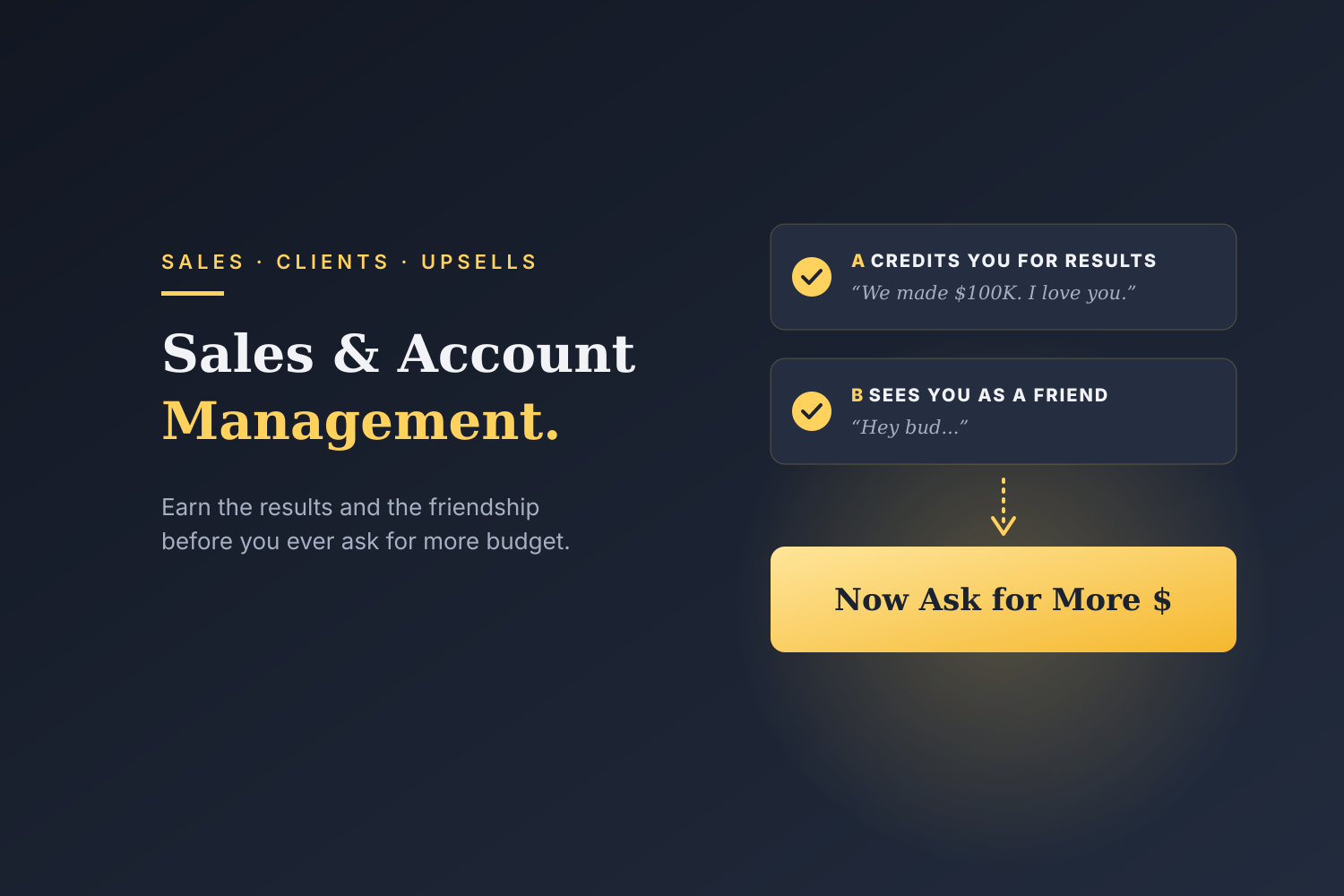
But before you’ll ever get more money, two things have to be true in the client’s mind:
- The client has acknowledged that YOU are driving the results.
Example: “We’ve made $100K in new sales from your internet marketing. I love you.” - You’ve moved into the “friend” bucket in their mind, not just another account rep.
Example: The client starts emails and calls with “Hey bud.”
Only after you’ve delivered that level of service and earned that kind of relationship can you shift into “sales mode” and ask for more money.
Ask Too Soon and You’ll Pay for It
If you ask too soon, you’ll lose trust, and it’s an uphill battle from there.
How on earth are you supposed to convince someone your services deserve more money if they haven’t said (out loud or in writing) that you’re responsible for the results, and they don’t see you as a friend? It’s borderline impossible.
Sure, you could ask anyway. But if you haven’t earned both, you’ll start a fire, damage the rapport, and push back the day you actually get the increase.
How to Ask for More Budget
Once you’ve earned the right to ask, make it easy for them to say yes. Get on the phone and walk through it like this:
- Recap the win in their numbers. “Over the last 90 days, you spent $15K and generated $100K in sales.”
- Show the opportunity. “We’re only capturing about 40% of the searches for your best keywords. We’re leaving customers on the table.”
- Make the ask specific. “If we increase the budget to $8K a month, I expect we can drive another 20 to 30 sales a month.”
- Lower the risk. “Let’s test it for 60 days. If the numbers don’t hold, we scale back.”
- Follow up in writing with a short email that recaps the numbers and the plan.
Results plus a specific plan plus low risk. That’s a yes almost every time.
Soft Skills Still Win
Succeeding in the new digital economy still requires people skills: soft skills.
According to research from Capgemini, there’s a growing gap in both digital and soft skills among young professionals. That means there’s opportunity.
The soft skills I’d focus on first:
- Listening: Hear what the client actually cares about, not what you assume.
- Translating: Turn data and jargon into plain English and dollars.
- Calm under pressure: When results dip, be the steady one on the call.
- Follow-through: Do what you said, when you said you would. Every time.
What’s Your Excuse?
That’s why this blog exists: to share my research and what’s worked for me. If you hustle, spend time learning, and do the right things, you can succeed in a digital career.
I had zero experience and zero connections in technology and digital marketing when I made the shift. Plus student loans.
What’s your excuse?
Leave a Reply