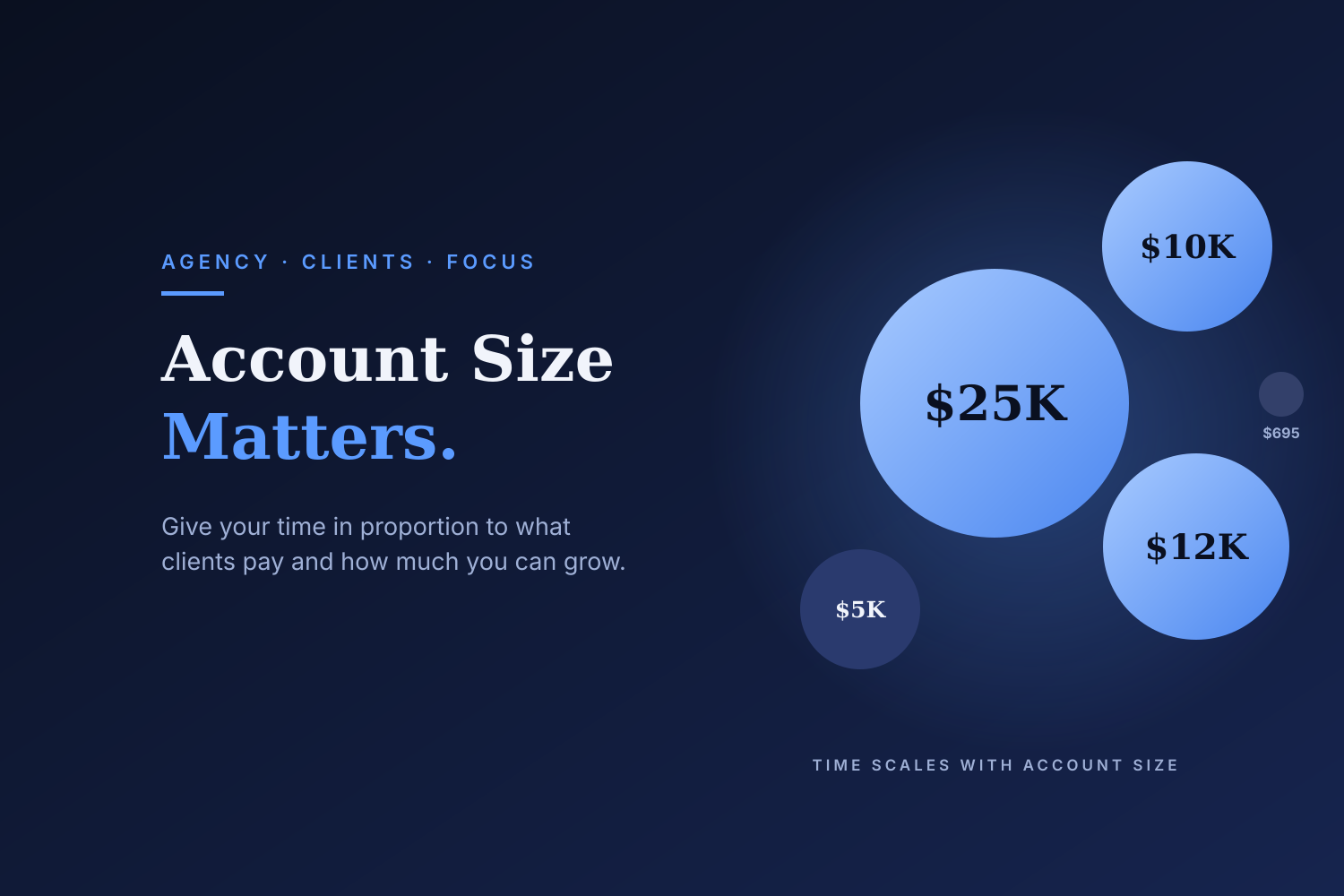
When a $695-a-month account is emailing you 5 times a day, wanting to change ads and test new things, they don’t get more of your time. They get to wait.
If they pay more, they get more time. Simple.
Your Time Follows the Money
I’m good at marketing and technology, and my services are in high demand. I have accounts paying $5K, $10K, $12K, and $25K a month. If you pay $695, you get that proportion of my time at the agency. If you don’t like it, you can find another CMO or another agency. You won’t get a higher level of service for that price.
A professional shouldn’t feel bad about these account management decisions. You have to manage your time, or needy, underperforming clients will eat all of it, leaving nothing for the big dogs: the whales.
The Whales Rarely Bother You
Funny enough, big accounts rarely take up much of your time. They’re busy running their businesses. They understand that successful businesspeople hire others to handle the functions they can’t, either because they don’t have the time or don’t have the skill.
Big clients hire you so they can stop thinking about marketing. Small clients often hire you and then try to do your job for you. That’s the difference.
You Can’t Please Everyone
Early on as an executive, you want to please everyone all the time. That’s not scalable.
As you gain experience prospecting, selling, and managing, you learn that the best accounts are what move your LQ needle. Focus on the accounts that matter. Period.
Some people will constantly pull your attention toward their problems, because they keep thinking small. Set boundaries in your own mental kingdom, so you never feel bad about not engaging with small thinking, underperformance, or laziness. Cut the fat to run faster. #darwinism
The Two-Fold Criteria
I’m not saying you shouldn’t serve your clients. Serve everyone to the best of your ability. What I am saying is to be smart and effective about how you serve them, based on two criteria:
- How much they pay you
- How well you can grow their business
That second one matters. A $1,500-a-month client with a great product, healthy margins, and an owner who listens can become your next $10K account. A $10K client with a broken offer who fights you on everything may never get better. Pay attention to both numbers: what they pay today, and what they could become.
Tier Your Book of Business
Here’s a simple way to put this into practice. Sort every account into tiers and match your service to the tier:
- Tier A (whales and high-potential accounts): Proactive strategy, weekly calls, fast responses, and your best thinking.
- Tier B (solid mid-size accounts): Biweekly check-ins, monthly reports, steady optimization.
- Tier C (small accounts): Monthly report, a set number of changes per month, and responses within 1 to 2 business days.
Tier C clients still get good work. They just don’t get your whole day.
How to Set Boundaries Without Losing Clients
Boundaries work best when they’re set upfront, not in the middle of a frustrating week:
- Define scope in the contract. Number of campaigns, changes per month, meetings, and reports.
- Set response-time expectations on day one. “I reply within one business day” stops the 5-emails-a-day spiral before it starts.
- Batch requests. Ask small clients to send changes in one weekly email instead of drip-feeding them.
- Offer the upgrade. When a client wants more time, don’t say no. Say, “Absolutely. Here’s the plan that includes that.” Now it’s their choice.
- Raise your minimums. If small accounts keep draining you, stop taking them. Your minimum retainer is a filter.
The Bottom Line
Your time is your inventory. Spend it where it earns the most and does the most good.
Account size matters. So does potential. Manage both, and stop feeling guilty about it.
Leave a Reply