We’re all stuck in these bodies. Might as well make them strong.
The human body really only does a handful of basic movements. The smart athlete trains those movements, with weights. Strength coach Dan John popularized this way of thinking, and it’s completely changed how I train.
The 5 Core Human Movements
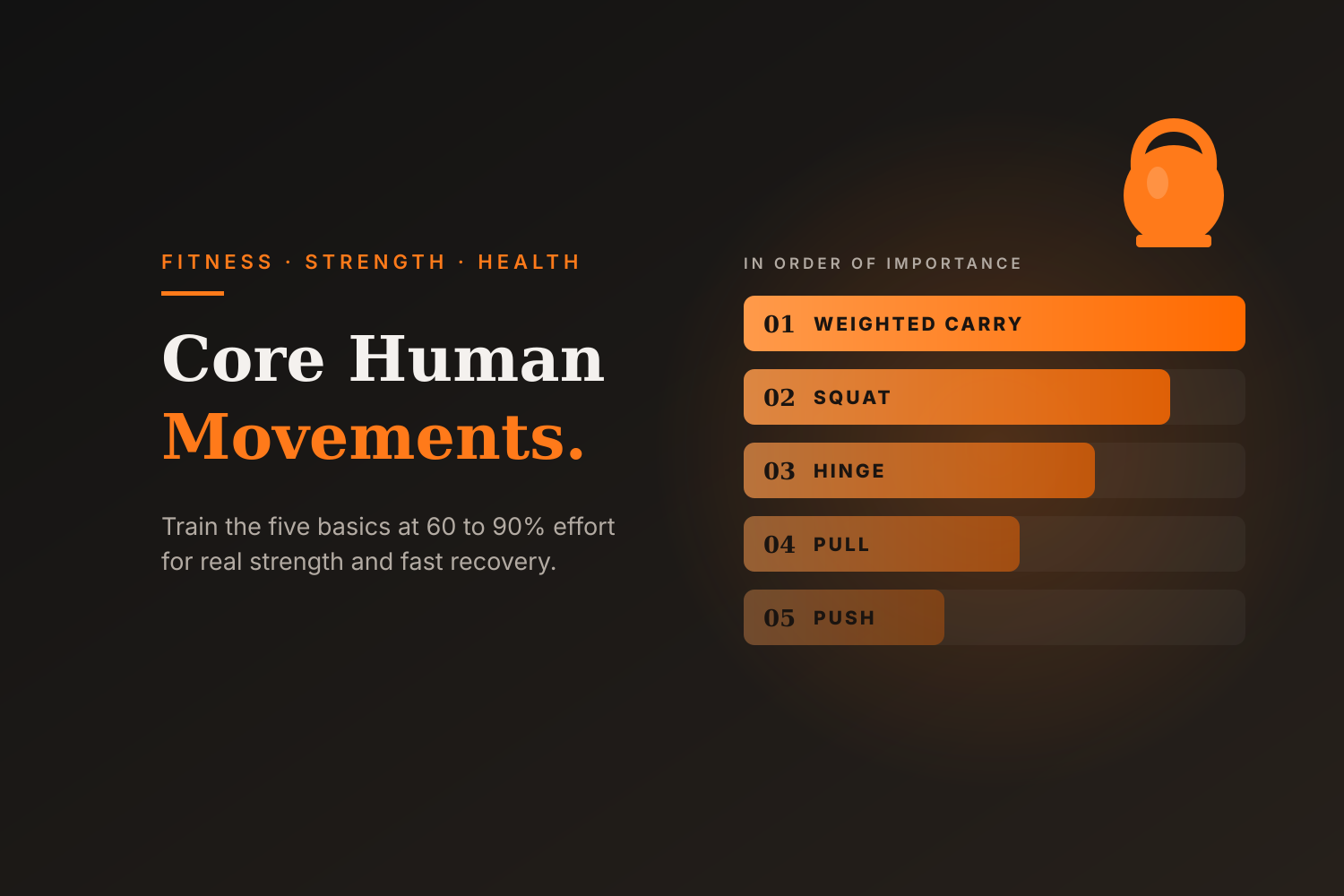
In order of importance:
- Weighted carry: farmer’s carries, suitcase carries, overhead carries
- Squat: goblet squats, front squats, back squats
- Hinge: deadlifts, kettlebell swings, Romanian deadlifts
- Pull: pull-ups, rows, chin-ups
- Push: overhead press, push-ups, bench press
Most Lifters Have It Backward
In my experience, most lifters and athletes treat that list in reverse order. That’s why you always see people benching, asking each other what they bench, or bragging about their deadlift.
Meanwhile, if you can clean and press a 70-pound dumbbell with proper form, that’s strength. But nobody talks about that movement, and you rarely see it at your local gym.
This is part of why America has a waistline problem. Most people do the wrong movements in the gym, skip intermittent fasting, and sleep and eat poorly. Good luck building a strong, resilient body with those habits.
Why Carries Come First
Carries look boring. Just pick up something heavy and walk. But they work everything at once: grip, core, shoulders, posture, and your ability to stay tight under load. It’s the most real-world strength there is. Groceries, luggage, a kid, a bag of concrete for your rental’s patio. Life is one long weighted carry.
Start simple: grab two heavy dumbbells or kettlebells and walk for 30 to 60 seconds. Stand tall, shoulders back, don’t let the weight pull you sideways. That’s it.
I Made the Same Mistakes
I made those mistakes too. I focused on isolation exercises, bench, cardio, and bent-over rows all the time. I still got somewhat stronger, but nothing compared to the gains I’ve seen since changing my training.
My time in the gym has actually decreased since I started focusing on compound movements across the five patterns: carry, squat, hinge, pull, and push.
At 29, I’m:
- The strongest I’ve ever been
- More flexible than ever
- Performing at the top of my game in every sport
- Sleeping well
- Pain-free
Stop Training to Soreness
Even sore muscles are becoming a thing of the past. I’ve found a smart lifter should only exert 60 to 90% of their max effort in any one session. This is the core idea behind the “Easy Strength” approach from Dan John and Pavel Tsatsouline.
I do still get sore after picking up knocks in a competitive soccer game or an eventful day snowboarding. But hardly ever from lifting. If I’m sore after a weight session, that’s a sign I lifted too much.
That’s the opposite of what I was told growing up. But based on my experience and research, if you’re sore, you’ll lift less often, and you’ll see minimal strength gains.
More Reps, Less Effort, More Often
For example, I could max out my squat and deadlift in one session, doing 10 to 25 hard reps, then spend 5 days recovering.
A better strategy I’ve found: aim for 50 to 65 total reps per session at 60 to 90% effort. Then come back two days later and do it again.
How do you know you’re at the right effort? Simple: always leave 2 or 3 reps in the tank. If your form starts breaking down or the bar slows to a crawl, you’re done with that set. Every set should feel like you could have done more.
A Sample Session
Here’s what a simple full-body day can look like, hitting all five movements:
- Goblet squat: 3 sets of 5
- Kettlebell swing or deadlift: 3 sets of 5
- Pull-ups or rows: 3 sets of 5
- Overhead press: 3 sets of 5
- Farmer’s carry: 3 trips of 30 to 60 seconds
That’s about 60 reps plus carries, in 45 minutes or less. Do it 2 to 3 times a week, add a little weight when it feels easy, and stay consistent.
Strength Is a Long Game
Sound familiar? It’s the same lesson as investing. Small, consistent deposits beat occasional heroic efforts. Compounding works on your body just like it works on your money.
Rinse and repeat for the rest of your life: real strength, healthy joints, fast recovery, and better sleep.
I’m not a doctor or a certified coach. This is what works for me. Talk to a professional before starting a new training program, especially if you have injuries.
Leave a Reply