Scott Trench’s book Set for Life completely changed how I think about true wealth.
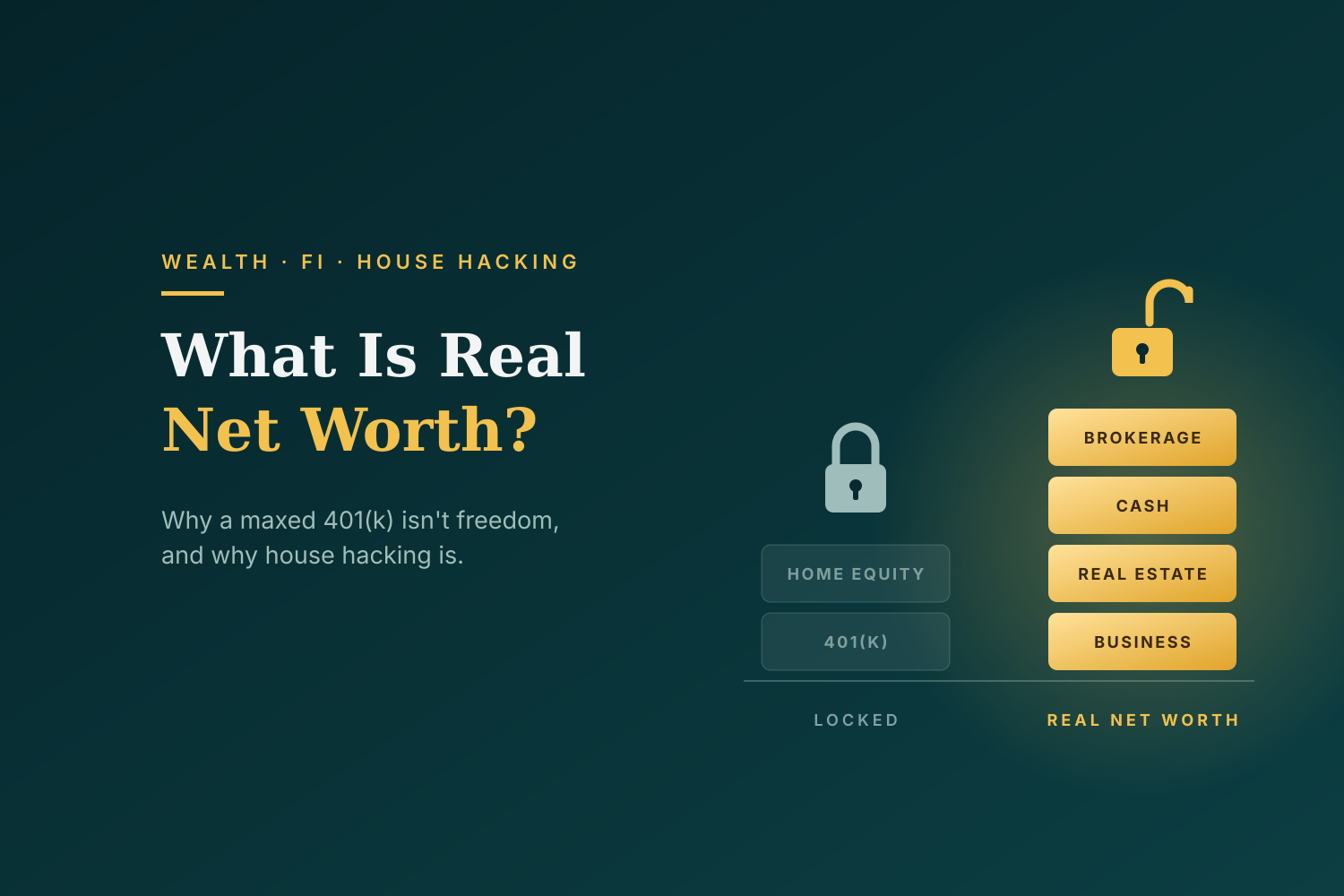
His big idea: retirement accounts aren’t true wealth for someone chasing early freedom. Why? You can’t access that money right now without paying a penalty.
What Counts as Real Net Worth
True assets are the ones you can actually use to buy your freedom:
- Brokerage accounts
- Cash
- Real estate (investment property, not your own home)
- Businesses
Here’s the simple formula I use:
Real net worth = total net worth − retirement accounts − home equity
Run that math on yourself. For most people, the number is a lot smaller than they expect. That number is your real progress toward early freedom.
Any ambitious aspiring early retiree should be building true assets steadily. And by early retiree, I mean a financially free person.
$2 Million in a 401(k) at 45 Isn’t Freedom
If you have $2 million in retirement accounts at 45, you’re not financially free. You’re still a wage slave. Why? That 401(k) money isn’t easily accessible. It’s nearly impossible to be financially free when your entire net worth is locked in a 401(k) and the equity in your home.
To be fair, there are ways to get at retirement money early. Roth IRA contributions (not earnings) can come out anytime. There’s the Rule of 55, Roth conversion ladders, and 72(t) payments. But they all come with rules, waiting periods, and fine print. That’s the point. Money you need a strategy and a CPA to touch isn’t the same as money you can deploy tomorrow.
Retirement accounts are still great. Take the employer match, always. Just don’t mistake them for your freedom fund.
The Script We’re All Taught
How crazy is it that we’re all taught growing up that maxing out a 401(k) and buying a home to live in is the way to build wealth? It’s hogwash!
To play devil’s advocate: teaching every young person that belief keeps people docile their entire lives. And docile, dependable employees are exactly what you need to build a big business. I suspect big corporations gained some influence over what schools teach, the kind of education that sends a fresh crop of robotic workers into the salt mines every year to work for 40 years and die with no money.
God forbid those employees start putting their money to work and building their own businesses in real estate and technology. That would mean no more employees!
Go Your Own Way
Dear reader: going your own way, managing your own money, and becoming self-employed is the right path!
I get that self-employment takes time to build. So while you figure that part out, maximize your income in a performance-based career. Not hourly. Not salaried. Merit-based. Sales, commissions, results-driven roles. That kind of work offers the biggest opportunities for income, professional growth, clients, and power.
The First $100K Is the Hardest
The first $100K of real net worth is the hardest to build. After that, wealth starts to snowball. Your processes get better, your experience widens, your network grows, and your wealth gets bigger and bigger.
Charlie Munger famously said the first $100K is a bitch. He was right. Push through it anyway. Everything gets easier on the other side.
House Hacking: My Favorite Strategy
My favorite strategy for growing real net worth is house hacking. It works!
In my opinion, every young person who doesn’t live in LA, NYC, or San Diego should be house hacking ASAP. Here’s the playbook:
- Buy a property you’ll live in with owner-occupant financing. That means a low down payment (often 3.5 to 5%) and a better interest rate than investor loans.
- Rent out the other units or rooms. Duplex, triplex, fourplex, or a single-family home rented by the room.
- Let the tenants cover most or all of your mortgage. Living for free (or close to it) is the fastest way to boost your savings rate.
- Live there for at least a year to meet the owner-occupancy requirements.
- Move out, keep it as a rental, and buy the next one.
Rinse and repeat. Grow your empire by at least one property a year until you’re financially free to do the next big thing.
Yes, you’ll live with roommates or next to tenants for a few years. Yes, it’s less glamorous than your own place. That’s the trade. A few years of inconvenience for decades of freedom. I’ll take that deal every single time.
Don’t Buy the Dream Home (Yet)
Do not buy a luxury home. Do not buy a primary home just to live in if early financial freedom is your goal. The math just doesn’t add up.
A home you live in alone costs you money every month: mortgage, taxes, insurance, maintenance. A house hack pays you, or at least pays for itself. One is a liability dressed up as an asset. The other is an actual asset.
The dream home can come later, bought with the cash flow from the rentals you built first.
House hack instead.
Leave a Reply