Every morning I write about whatever my mind feels like thinking about. Lately, it’s been passive income from different asset classes. Here are those thoughts.
The Paper Asset Math
With a $99,000 nest egg, contributing $2,500 a month for the next 28.5 years (until I can withdraw from tax-advantaged accounts without penalty), my portfolio should land around $3,079,165.
Using the 4% rule, that’s:
- $123,166 a year
- $10,263 a month
For the math nerds: that projection assumes roughly a 6.5% average annual return. Of the $3 million, I’d only contribute about $954,000 out of pocket. Compounding does the other $2.1 million. That’s the eighth wonder of the world at work.
Don’t Forget Inflation
Here’s the catch nobody likes to talk about: $3 million in 28 years won’t buy what $3 million buys today.
At 2.5% average inflation, that $3.08 million is worth about $1.5 million in today’s dollars. And that $10,263 a month feels more like $5,000 a month does now.
Still a great outcome. But it’s a good reminder to plan in today’s dollars so you don’t fool yourself. A big number decades out always looks bigger than it really is.
Keep Two Years of Cash
A smart money strategy is keeping 2 years of expenses in cash. You use it when the market is in a recession or depression.
In those times, you don’t touch your paper asset portfolio. Selling stocks while they’re down locks in the losses and permanently shrinks your future monthly income. Instead, you live off your cash and buy your portfolio time to recover.
This has a fancy name, sequence-of-returns risk. A crash in the first few years of retirement does way more damage than a crash 20 years in, because you’re forced to sell low right when your portfolio is biggest. Two years of cash is cheap insurance against the worst-case timing.
In a downturn, I’d also lean on my rental income. By then, my properties will be free and clear, or a few years away from it. An extra $2,500 to $5,000 a month in profit would be wonderful.
$5,000 a Month Would Change My Life
As a single man, $5,000 a month in passive income would change my life. I could do almost everything I want:
- Travel abroad for months at a time
- Golf, snowboard, play soccer, and lift
- Socialize, eat out, and go to concerts
The $60K Real Estate Vision
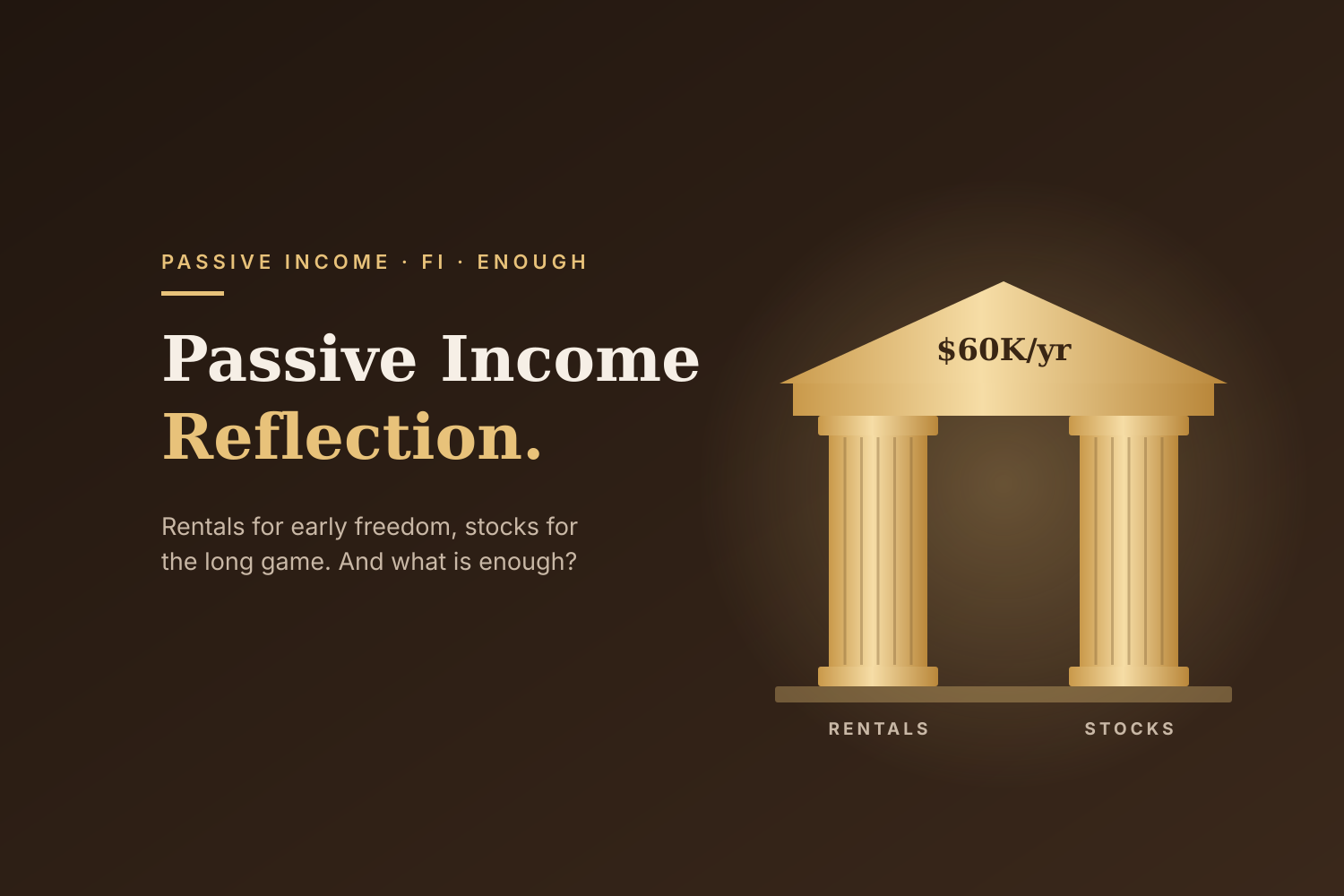
My real estate business vision is $60,000 a year in passive income. At that level, I’m free to work on big things that could make me a very wealthy man, if I choose to. The key, I believe, is building that $60K-a-year foundation first. All the pundits and the media will scream, “That’s not enough!”
$60,000 a year is $5,000 a month. Based on my current real estate model, that’s:
- 5 more properties if I self-manage
- 6 more properties if I hire a property manager to make it truly passive
That one extra property is the price of getting my time back. Worth it.
My Two-Engine Plan
My philosophy for financial independence runs on two engines:
- Real estate for the short term. Rental cash flow is what gets me to early financial independence. It pays now, it’s leveraged, and it comes with tax advantages.
- Paper assets for the long term. Index funds compound quietly in the background for decades and become additional pillars of income in my old age.
Real estate buys my freedom early. Paper assets protect it later. Each engine covers the other’s weak spot.
But What Is Enough?
In my opinion, $60K a year passively is enough. I can always spend more, but that goes against my frugal values.
When you finally get the nice sports car or the full-size pickup, the jet ski, the fine dining, the designer clothes, you’re still going to be the same person. You’ll just own a lot of stuff.
Those things weigh you down. They make you less flexible and less adaptable. They make nomad travel harder. And they create a life where you have to keep working just to pay for the upkeep of everything you own.
That’s lifestyle creep, and it’s the silent killer of financial freedom. Every raise gets absorbed by a bigger lifestyle, and the finish line keeps moving. The fix isn’t earning more. It’s deciding what enough looks like before the money shows up.
Is that truly a good way to live this one short life?
Leave a Reply